PDF · English
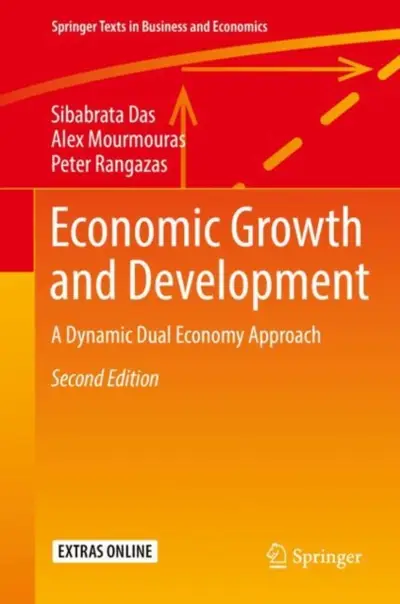
Economic Growth and Development
A Dynamic Dual Economy Approach
Price and availability
$74.99
Available in: Andorra, Austria, Australia, Belgium, Bulgaria, Canada, Switzerland, Cyprus, Czechia, Germany, Denmark, Estonia, Spain, Finland, France, United Kingdom, Guernsey, Greece, Croatia, Hungary, Ireland, Isle of Man, Iceland, Italy, Jersey, Japan, Liechtenstein, Lithuania, Luxembourg, Latvia, Monaco, Malta, Netherlands, Norway, Poland, Portugal, Romania, Sweden, Slovenia, Slovakia, San Marino, United States, Vatican City, South Africa
Stores: US, UK, Canada, EU, Australia.
Sign in to buyThe price is re-checked by the server before payment.
For personal use under the eBook licence.
- Format
- DRM
- Not stated by the publisher
- Language
- English
- Publisher
- Springer International Publishing
- Published
- 16 August 2018
- ISBN
- 9783319897554
- Subjects
- Macroeconomics, Monetary economics, Economic growth, Development economics & emerging economies, Macroeconomics, Economic growth, Development economics and emerging economies
About this book
This text is an introduction to the newer features of growth theory that are particularly useful in examining the issues of economic development. Growth theory provides a rich and versatile analytical framework through which fundamental questions about economic development can be examined. Structural transformation, in which developing countries transition from traditional production in largely rural areas to modern production in largely urban areas, is an important causal force in creating early economic growth, and as such, is made central in this approach. Towards this end, the authors augment the Solow model to include endogenous theories of saving, fertility, human capital, institutional arrangements, and policy formation, creating a single two-sector model of structural transformation. Based on applied research and practical experiences in macroeconomic development, the model in this book presents a more rigorous, quantifiable, and explicitly dynamic dual economy approach todevelopment. Common microeconomic foundations and notation are used throughout, with each chapter building on the previous material in a continuous flow. Revised and updated to include more exercises for guided self study, as well as a technical appendix covering required mathematical topics beyond calculus, the second edition is appropriate for both upper undergraduate and graduate students studying development economics and macroeconomics.
Bibliographic data © Gardners Books Ltd.