PDF · English
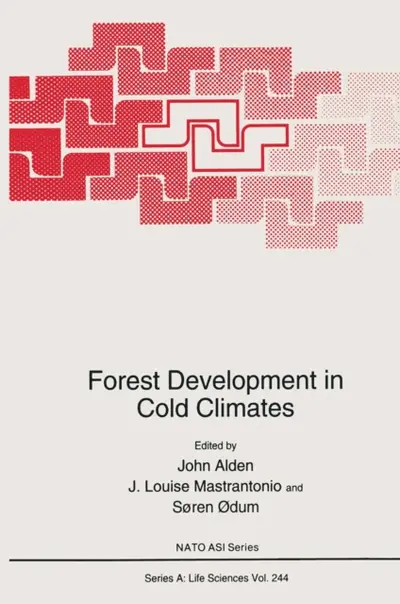
Forest Development in Cold Climates
Price and availability
$242.99
Available in: Andorra, Austria, Australia, Belgium, Bulgaria, Canada, Switzerland, Cyprus, Czechia, Germany, Denmark, Estonia, Spain, Finland, France, United Kingdom, Guernsey, Greece, Croatia, Hungary, Ireland, Isle of Man, Iceland, Italy, Jersey, Japan, Liechtenstein, Lithuania, Luxembourg, Latvia, Monaco, Malta, Netherlands, Norway, Poland, Portugal, Romania, Sweden, Slovenia, Slovakia, San Marino, United States, Vatican City, South Africa
Stores: US, UK, Canada, EU, Australia.
Sign in to buyThe price is re-checked by the server before payment.
For personal use under the eBook licence.
- Format
- DRM
- Not stated by the publisher
- Language
- English
- Publisher
- Springer US
- Published
- 29 June 2013
- ISBN
- 9781489916006
- Subjects
- Medical genetics, Ecological science, the Biosphere, Botany & plant sciences, Zoology & animal sciences, Environmental management, Forestry & silviculture: practice & techniques, Medical genetics, Ecological science, the Biosphere, Botany and plant sciences, Zoology and animal sciences, Environmental management, Forestry and silviculture
About this book
As forests decline in temperate and tropical climates, highly-developed countries and those striving for greater economic and social benefits are beginning to utilize marginal forests of high-latitude and mountainous regions for resources to satisfy human needs. The benefits of marginal forests range from purely aesthetic to providing resources for producing many goods and services demanded by a growing world population. Increased demands for forest resources and amenities and recent warming of high- latitude climates have generated interest in reforestation and afforestation of marginal habitats in cold regions. Afforestation of treeless landscapes improves the environment for human habitation and provides for land use and economic prosperity. Trees are frequently planted in cold climates to rehabilitate denuded sites, for the amenity of homes and villages, and for wind shelter, recreation, agroforestry, and industrial uses. In addition, forests in cold climates reduce the albedo of the earth's surface in winter, and in summer they are small but significant long-lived sinks for atmospheric carbon dioxide. Finally, growth and reproductive success of forests at their geographic limits are sensitive indices of climatic change. As efforts to adapt forests to cold climates increase, however, new afforestation problems arise and old ones intensify. Austral, northern, and altitudinal tree limits are determined by many different factors. Current hypotheses for high-latitude tree limits are based on low growing-season temperatures that inhibit plant development and reproduction.
Bibliographic data © Gardners Books Ltd.