EPUB · English
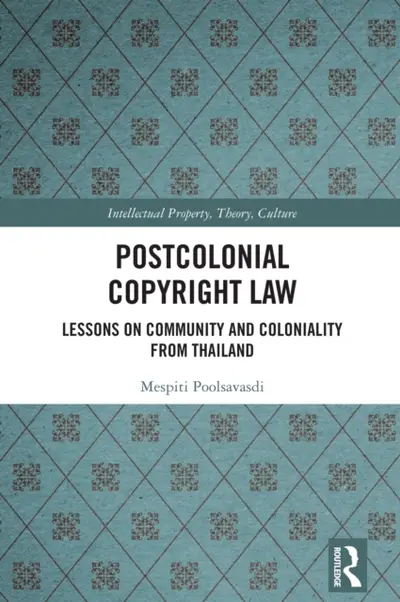
Postcolonial Copyright Law
Lessons on Community and Coloniality from Thailand
Price and availability
$64.99
Available in: Andorra, Austria, Australia, Belgium, Bulgaria, Canada, Switzerland, Cyprus, Czechia, Germany, Denmark, Estonia, Spain, Finland, France, United Kingdom, Guernsey, Greece, Croatia, Hungary, Ireland, Isle of Man, Iceland, Italy, Jersey, Japan, Liechtenstein, Lithuania, Luxembourg, Latvia, Monaco, Malta, Netherlands, Norway, Poland, Portugal, Romania, Sweden, Slovenia, Slovakia, San Marino, United States, Vatican City, South Africa
Stores: US, UK, Canada, EU, Australia.
Sign in to buyThe price is re-checked by the server before payment.
For personal use under the eBook licence.
- Format
- EPUB
- DRM
- Not stated by the publisher
- Language
- English
- Publisher
- Taylor & Francis
- Published
- 15 August 2025
- ISBN
- 9781040414033
- Subjects
- Thailand, National liberation & independence, post-colonialism, Jurisprudence & general issues, International law, Intellectual property law, Copyright law, Jurisprudence and general issues, International law, Intellectual property law, Copyright law, NHTR
About this book
This book appraises postcolonial perspectives to rethink the meaning of copyright and makes suggestions for its future within the global landscape of intellectual property law.Drawing on the experience of Thailand as a case study, a country with a unique yet marginal position in discussions on colonialism, the book offers valuable insights for the international field of copyright law. Thai copyright law emerged in an era when the threat of European colonial powers inspired local ruling elites to embark on a quest for modernisation and establish a modern absolutist state. One can observe similar dynamics in the recent promotion of Thailand's Creative Economy. Contrary to these top-down developments, the book argues for greater attention to attitudes and practices on the ground. Taking an interdisciplinary approach informed by film studies, area studies, decolonial studies, and legal sociology, the book makes a case to redefine copyright as a community resource.The book will be of interest to researchers in the field of copyright law, postcolonial and decolonial studies, and sociolegal studies.
Bibliographic data © Gardners Books Ltd.