PDF · English
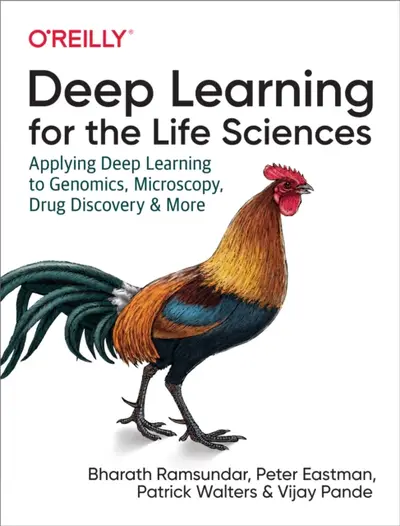
Deep Learning for the Life Sciences
Applying Deep Learning to Genomics, Microscopy, Drug Discovery, and More
Price and availability
$73.99
Available in: Andorra, Austria, Australia, Belgium, Bulgaria, Canada, Switzerland, Cyprus, Czechia, Germany, Denmark, Estonia, Spain, Finland, France, United Kingdom, Guernsey, Greece, Croatia, Hungary, Ireland, Isle of Man, Iceland, Italy, Jersey, Japan, Liechtenstein, Lithuania, Luxembourg, Latvia, Monaco, Malta, Netherlands, Norway, Poland, Portugal, Romania, Sweden, Slovenia, Slovakia, San Marino, United States, Vatican City, South Africa
Stores: US, UK, Canada, EU, Australia.
Sign in to buyThe price is re-checked by the server before payment.
For personal use under the eBook licence.
- Format
- DRM
- Not stated by the publisher
- Language
- English
- Publisher
- O'Reilly Media
- Published
- 10 April 2019
- ISBN
- 9781492039808
- Subjects
- Genetics (non-medical), Genetics (non-medical)
About this book
Deep learning has already achieved remarkable results in many fields. Now its making waves throughout the sciences broadly and the life sciences in particular. This practical book teaches developers and scientists how to use deep learning for genomics, chemistry, biophysics, microscopy, medical analysis, and other fields.Ideal for practicing developers and scientists ready to apply their skills to scientific applications such as biology, genetics, and drug discovery, this book introduces several deep network primitives. Youll follow a case study on the problem of designing new therapeutics that ties together physics, chemistry, biology, and medicinean example that represents one of sciences greatest challenges.Learn the basics of performing machine learning on molecular dataUnderstand why deep learning is a powerful tool for genetics and genomicsApply deep learning to understand biophysical systemsGet a brief introduction to machine learning with DeepChemUse deep learning to analyze microscopic imagesAnalyze medical scans using deep learning techniquesLearn about variational autoencoders and generative adversarial networksInterpret what your model is doing and how its working
Bibliographic data © Gardners Books Ltd.