EPUB · English
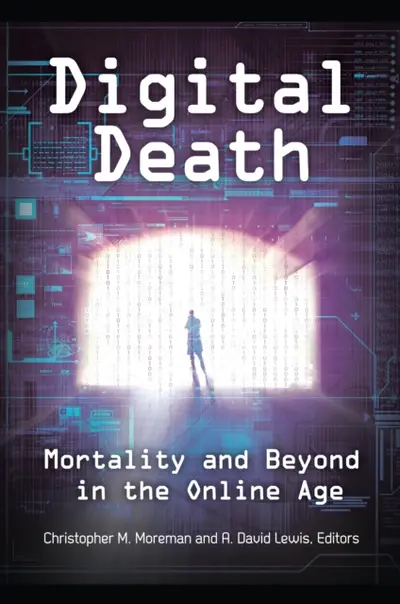
Digital Death
Mortality and Beyond in the Online Age
Price and availability
$72.99
Available in: Andorra, Austria, Australia, Belgium, Bulgaria, Canada, Switzerland, Cyprus, Czechia, Germany, Denmark, Estonia, Spain, Finland, France, United Kingdom, Guernsey, Greece, Croatia, Hungary, Ireland, Isle of Man, Iceland, Italy, Jersey, Japan, Liechtenstein, Lithuania, Luxembourg, Latvia, Monaco, Malta, Netherlands, Norway, Poland, Portugal, Romania, Sweden, Slovenia, Slovakia, San Marino, United States, Vatican City, South Africa
Stores: US, UK, Canada, EU, Australia.
Sign in to buyThe price is re-checked by the server before payment.
For personal use under the eBook licence.
- Format
- EPUB
- DRM
- Not stated by the publisher
- Language
- English
- Publisher
- Bloomsbury Publishing (USA)
- Published
- 20 October 2014
- Pages
- 272
- ISBN
- 9781440831331
- Subjects
- Religion: general, Sociology: death & dying, Ethical & social aspects of IT, Sociology: death and dying, QRA, Digital and information technologies: social and ethical aspects
About this book
This fascinating work explores the meaning of death in the digital age, showing readers the new ways digital technology allows humans to approach, prepare for, and handle their ultimate destiny.With DeadSocial(TM) one can create messages to be published to social networks after death. Facebook's "e;If I Die"e; enables users to create a video or text message for posthumous publication. Twitter _LIVESON accounts will keep tweeting even after the user is gone. There is no doubt that the digital age has radically changed options related to death, dying, grieving, and remembering, allowing people to say goodbye in their own time and their own unique way. Drawing from a range of academic perspectives, this book is the only serious study to focus on the ways in which death, dying, and memorialization appear in and are influenced by digital technology. The work investigates phenomena, devices, and audiences as they affect mortality, remembrances, grieving, posthumous existence, and afterlife experience. It examines the markets to which the providers of such services are responding, and it analyzes the degree to which digital media is changing views and expectations related to death. Ultimately, the contributors seek to answer an even more important question: how digital existences affect both real-world perceptions of life's end and the way in which lives are actually lived.
Bibliographic data © Gardners Books Ltd.