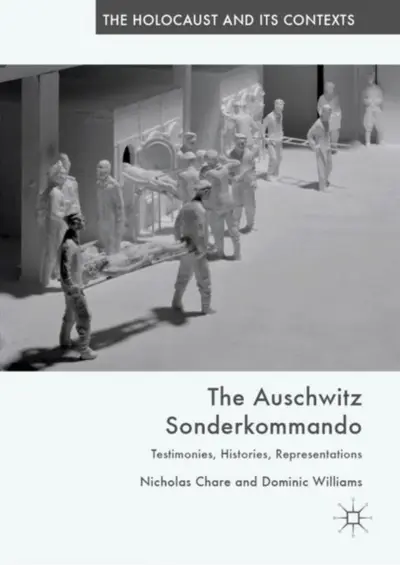
PDF · English
Auschwitz Sonderkommando
Testimonies, Histories, Representations
Price and availability
$74.99
Available in: Andorra, Austria, Australia, Belgium, Bulgaria, Canada, Switzerland, Cyprus, Czechia, Germany, Denmark, Estonia, Spain, Finland, France, United Kingdom, Guernsey, Greece, Croatia, Hungary, Ireland, Isle of Man, Iceland, Italy, Jersey, Japan, Liechtenstein, Lithuania, Luxembourg, Latvia, Monaco, Malta, Netherlands, Norway, Poland, Portugal, Romania, Sweden, Slovenia, Slovakia, San Marino, United States, Vatican City, South Africa
Stores: US, UK, Canada, EU, Australia.
Sign in to buyThe price is re-checked by the server before payment.
For personal use under the eBook licence.
- Format
- DRM
- Not stated by the publisher
- Language
- English
- Publisher
- Springer International Publishing
- Published
- 15 February 2019
- ISBN
- 9783030114916
- Subjects
- Poland, c 1939 to c 1945 (including WW2), Historiography, European history, Modern history to 20th century: c 1700 to c 1900, Social & cultural history, The Holocaust, Second World War, History, Historiography, European history, Social and cultural history, Second World War
About this book
This book is the first to bring together analyses of the full range of post-war testimony given by survivors of the Sonderkommando of Auschwitz-Birkenau. The Auschwitz Sonderkommando were slave labourers in the gas chambers and crematoria, forced to process and dispose of the bodies of those who were murdered. They have been central to a number of key topics in post-war debates about the Shoah: collaboration, moral compromise and survival, resistance, representation, and the possibility of bearing witness. Their testimony however has mostly met with a reluctance to engage in depth with it. Moving from testimonies produced within the event, the Scrolls of Auschwitz and the Sonderkommando photographs, to testimonies given at trials and for video archives, and to the paintings of David Olere and the film Shoah by Claude Lanzmann, this book demonstrates the importance of their witnessing in the post-war memory of the Holocaust, and provides vital new insights into the questions of representation, memory, gender, and the Shoah.
Bibliographic data © Gardners Books Ltd.