EPUB · English
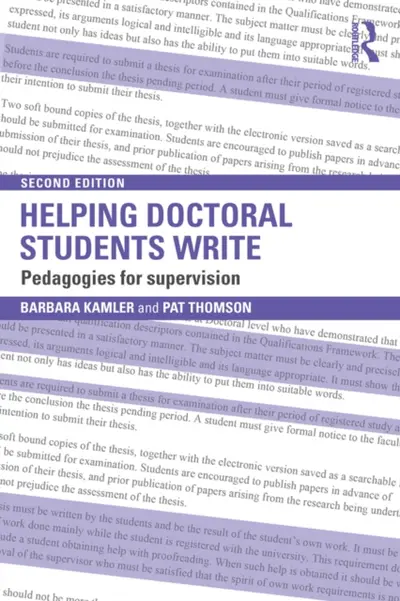
Helping Doctoral Students Write
Pedagogies for supervision
Price and availability
$67.99
Available in: Andorra, Austria, Australia, Belgium, Bulgaria, Canada, Switzerland, Cyprus, Czechia, Germany, Denmark, Estonia, Spain, Finland, France, United Kingdom, Guernsey, Greece, Croatia, Hungary, Ireland, Isle of Man, Iceland, Italy, Jersey, Japan, Liechtenstein, Lithuania, Luxembourg, Latvia, Monaco, Malta, Netherlands, Norway, Poland, Portugal, Romania, Sweden, Slovenia, Slovakia, San Marino, United States, Vatican City, South Africa
Stores: US, UK, Canada, EU, Australia.
Sign in to buyThe price is re-checked by the server before payment.
For personal use under the eBook licence.
- Format
- EPUB
- DRM
- Not stated by the publisher
- Language
- English
- Publisher
- Taylor & Francis
- Published
- 21 March 2014
- ISBN
- 9781317802129
- Subjects
- Writing & editing guides, Education, Teaching staff, Higher & further education, tertiary education, Study & learning skills: general, Teacher training, Teaching skills and techniques
About this book
Helping Doctoral Students Write offers a proven approach to effective doctoral writing. By treating research as writing and writing as research, the authors offer pedagogical strategies for doctoral supervisors that will assist the production of well-argued and lively dissertations. It is clear that many doctoral candidates find research writing complicated and difficult, but the advice they receive often glosses over the complexities of writing and/or locates the problem in the writer. Kamler and Thomson provide a highly effective framework for scholarly work that is located in personal, institutional and cultural contexts. The pedagogical approach developed in the book is based on the notion of writing as a social practice. This approach allows supervisors to think of doctoral writers as novices who need to learn new ways with words as they enter the discursive practices of scholarly communities. This involves learning sophisticated writing practices with specific sets of conventions and textual characteristics. The authors offer supervisors practical advice on helping with commonly encountered writing tasks such as the proposal, the journal abstract, the literature review and constructing the dissertation argument.The first edition of this book has helped many academics and thousands of research students produce better written material. Now fully updated the second edition includes: Examples from a broader range of academic disciplines A new chapter on writing from the thesis for peer reviewed journals More advice on reading and note taking, performance and conferences, Further information on developing a personal academic writing style, and Advice on the use of social media (blogs, tweets and wikis) to create trans-disciplinary and trans-national networks and conversations. Their discussion of the complexities of forming a scholarly identity is illustrated throughout by stories and writings of actual doctoral students.In conclusion, they present a persuasive and proven argument that universities must move away from simply auditing supervision to supporting the development of scholarly research communities. Any supervisor keen to help their students develop as academics will find the ideas and practical solutions presented in this book fascinating and insightful reading.
Bibliographic data © Gardners Books Ltd.