PDF · English
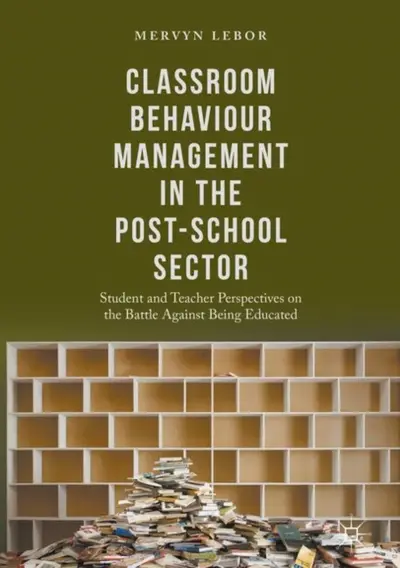
Classroom Behaviour Management in the Post-School Sector
Student and Teacher Perspectives on the Battle Against Being Educated
Price and availability
$40.99
Available in: Andorra, Austria, Australia, Belgium, Bulgaria, Canada, Switzerland, Cyprus, Czechia, Germany, Denmark, Estonia, Spain, Finland, France, United Kingdom, Guernsey, Greece, Croatia, Hungary, Ireland, Isle of Man, Iceland, Italy, Jersey, Japan, Liechtenstein, Lithuania, Luxembourg, Latvia, Monaco, Malta, Netherlands, Norway, Poland, Portugal, Romania, Sweden, Slovenia, Slovakia, San Marino, United States, Vatican City, South Africa
Stores: US, UK, Canada, EU, Australia.
Sign in to buyThe price is re-checked by the server before payment.
For personal use under the eBook licence.
- Format
- DRM
- Not stated by the publisher
- Language
- English
- Publisher
- Springer International Publishing
- Published
- 30 July 2017
- ISBN
- 9783319570518
- Subjects
- Organization & management of education, Adult education, continuous learning, Teaching skills & techniques, Educational psychology, Education: examinations and assessment, Educational administration and organization, Schools and pre-schools, Teacher training, Adult education, continuous learning
About this book
This book listens to the voices of post-school teachers, managers, theorists, trainees, teacher educators and students talking about the battle against being educated. It analyses models of classroom behaviour management, with examples of theory critiquing practice and practice criticizing theory. The contextual pressures of manageralism, demands imposed by Ofsted, economic survival for institutions based on student numbers, and mandatory attendance requirements have all meant ever-increasing pressures on teachers dealing with students' violent, disruptive and challenging behaviours, resulting in some highly disordered classrooms in many institutions. Lebor examines the attitudes of stakeholders, including disruptive students, teachers, trainees and managers, and explores a range of issues such as entering the classroom, abuse of computers and technology equipment, overt violence in classrooms, and counter-productive assessment processes, as well as exploring a range of available solutions to the problem. The book will be compelling reading for teachers, teacher educators, trainees, policy-makers, managers in education, but also anyone interested in education and training.
Bibliographic data © Gardners Books Ltd.