PDF · German
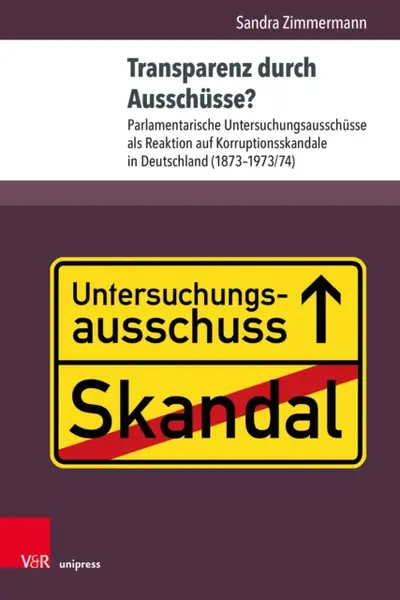
Transparenz durch Ausschüsse?
Parlamentarische Untersuchungsausschüsse als Reaktion auf Korruptionsskandale in Deutschland (1873–1973/74)
Price and availability
$57.99
Available in: Andorra, Austria, Australia, Belgium, Bulgaria, Canada, Switzerland, Cyprus, Czechia, Germany, Denmark, Estonia, Spain, Finland, France, United Kingdom, Guernsey, Greece, Croatia, Hungary, Ireland, Isle of Man, Iceland, Italy, Jersey, Japan, Liechtenstein, Lithuania, Luxembourg, Latvia, Monaco, Malta, Netherlands, Norway, Poland, Portugal, Romania, Sweden, Slovenia, Slovakia, San Marino, United States, Vatican City, South Africa
Stores: US, UK, Canada, EU, Australia.
Sign in to buyThe price is re-checked by the server before payment.
For personal use under the eBook licence.
- Format
- DRM
- Not stated by the publisher
- Language
- German
- Publisher
- Brill Deutschland GmbH
- Published
- 10 July 2023
- ISBN
- 9783847015482
- Subjects
- 20th century, Social & cultural history, Political corruption, Germany, West Germany, Corruption in politics, government and society, Social and cultural history
About this book
Dem Begriff »Transparenz« kam erst ab den 1970er-Jahren eine politische Bedeutung zu. Dennoch zeigt Sandra Zimmermann anhand von sechs Fallbeispielen, dass bereits seit dem Deutschen Kaiserreich über Transparenz diskutiert wurde. Sie wurde insbesondere als ein Gegenmittel zu Korruption begriffen und somit im Zusammenhang mit Korruptionsskandalen gefordert. Parlamentarische Untersuchungsausschüsse bzw. -kommissionen, die häufig zur Aufklärung solcher Skandale eingesetzt wurden, spielten dabei eine wichtige Rolle. In ihnen wurde Transparenz gefordert und über sie diskutiert. Die Ausschüsse sollten durch transparente Ermittlungen den Skandal untersuchen, das Parlament reinigen und die Bevölkerung beruhigen./p>The term "transparency" only gained political significance from the 1970s onwards. Nevertheless, Sandra Zimmermann shows, on the basis of six case studies, that transparency has been discussed since the German Empire (Kaiserreich). It was understood as an antidote to corruption and thus demanded in connection with corruption-scandals. Parliamentary committees of enquiry or commissions of enquiry, which were often set up to investigate such scandals, played an important role in this context. Transparency was demanded and discussed in them. The committees were supposed to investigate the scandal through transparent investigations, to cleanse parliament and to reassure the population after such a scandal.
Bibliographic data © Gardners Books Ltd.