PDF · English
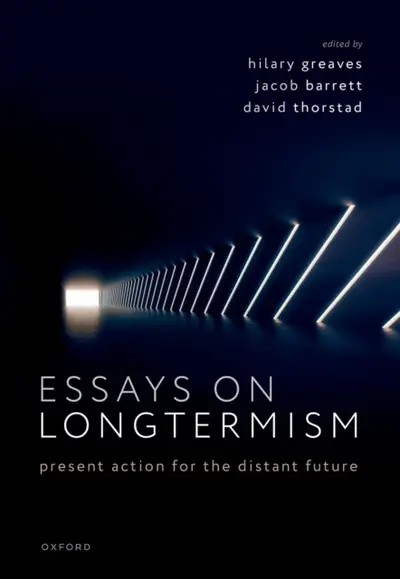
Essays on Longtermism
Present Action for the Distant Future
Price and availability
$127.99
Available in: Andorra, Austria, Australia, Belgium, Bulgaria, Canada, Switzerland, Cyprus, Czechia, Germany, Denmark, Estonia, Spain, Finland, France, United Kingdom, Guernsey, Greece, Croatia, Hungary, Ireland, Isle of Man, Iceland, Italy, Jersey, Japan, Liechtenstein, Lithuania, Luxembourg, Latvia, Monaco, Malta, Netherlands, Norway, Poland, Portugal, Romania, Sweden, Slovenia, Slovakia, San Marino, United States, Vatican City, South Africa
Stores: US, UK, Canada, EU, Australia.
Sign in to buyThe price is re-checked by the server before payment.
For personal use under the eBook licence.
- Format
- DRM
- Not stated by the publisher
- Language
- English
- Publisher
- Oxford University Press
- Published
- 25 September 2025
- ISBN
- 9780192883865
- Subjects
- Ethics & moral philosophy, Social & political philosophy, Economic theory & philosophy, Economic theory and philosophy, Ethics and moral philosophy, Social and political philosophy
About this book
This is an open access title. It is available to read and download as a free PDF version on Oxford Academic and is made available under a Creative Commons Attribution-Non Commercial-No Derivatives 4.0 International licence.Longtermism, broadly speaking, is the view that positively influencing the long-term future is one of the key moral priorities of our time. Calls for taking a long-term view towards global problems such as climate change and poverty are familiar, typically urging us to plan on a scale of decades or perhaps a century. By contrast, longtermism asks us to take seriously the idea that what we should do right now may depend on the effects of our actions thousands, even millions, of years into the future. Essays on Longtermism brings together leading scholars to discuss four sets of overlapping questions raised by the longtermist approach. First, should we accept some version of longtermism? Second, to what extent can we predict and control the far future? Third, which ethical priorities are recommended by longtermism, and how revisionary are they? Finally, what implications would longtermism have for the design or reform of social, political, and legal institutions? Contributors, who include both supporters and critics of longtermism, are drawn from a range of disciplines including philosophy, economics, psychology, law, political science, and mathematics, and from private industry.
Bibliographic data © Gardners Books Ltd.