EPUB · English
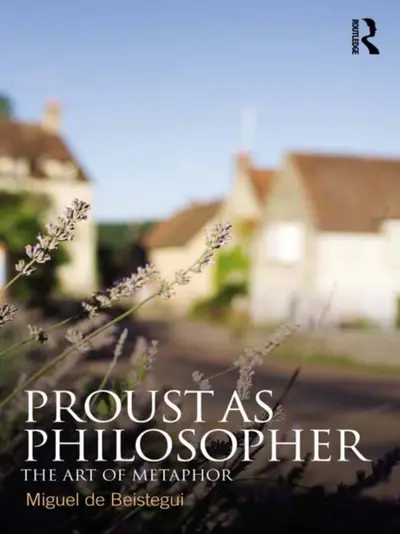
Proust as Philosopher
The Art of Metaphor
Price and availability
$70.99
Available in: Andorra, Austria, Australia, Belgium, Bulgaria, Canada, Switzerland, Cyprus, Czechia, Germany, Denmark, Estonia, Spain, Finland, France, United Kingdom, Guernsey, Greece, Croatia, Hungary, Ireland, Isle of Man, Iceland, Italy, Jersey, Japan, Liechtenstein, Lithuania, Luxembourg, Latvia, Monaco, Malta, Netherlands, Norway, Poland, Portugal, Romania, Sweden, Slovenia, Slovakia, San Marino, United States, Vatican City, South Africa
Stores: US, UK, Canada, EU, Australia.
Sign in to buyThe price is re-checked by the server before payment.
For personal use under the eBook licence.
- Format
- EPUB
- DRM
- Not stated by the publisher
- Language
- English
- Publisher
- Taylor & Francis
- Published
- 12 November 2012
- ISBN
- 9781135722593
- Subjects
- French, Literary theory, Literary studies: from c 1900 -, Literary studies: fiction, novelists & prose writers, Philosophy: aesthetics, Literary studies: fiction, novelists and prose writers, Philosophy: aesthetics
About this book
Marcel Proust's In Search of Lost Time has long fascinated philosophers for its complex accounts of time, personal identity and narrative, amongst many other themes. Proust as Philosopher: The Art of Metaphor is the first book to try and connect Proust's implicit ontology of experience with the question of style, and of metaphor in particular.Miguel de Beistegui begins with an observation: throughout In Search of Lost Time, the two main characters seem prone to chronic dissatisfaction in matters of love, friendship and even art. Reality always falls short of expectation. At the same time, the narrator experiences unexpected bouts of intense elation, the cause and meaning of which remain elusive. Beistegui argues we should understand these experiences as acts of artistic creation, and that this is why Proust himself wrote that true life is the life of art.He goes on to explore the nature of these joyful and pleasurable experiences and the transformation required of art, and particularly literature, if it is to incorporate them. He concludes that Proust revolutionises the idea of metaphor, extending beyond the confines of language to understand the nature of lived, bodily experience.
Bibliographic data © Gardners Books Ltd.