EPUB · English
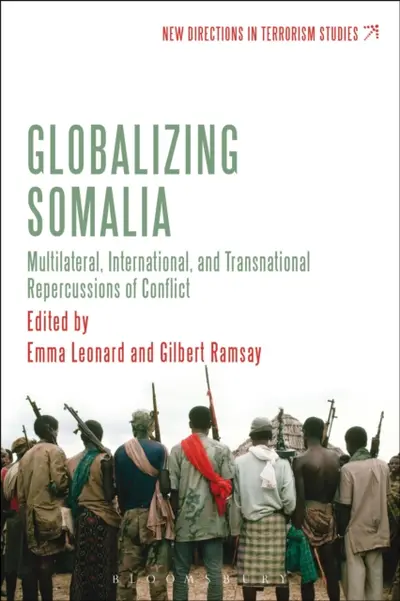
Globalizing Somalia
Multilateral, International and Transnational Repercussions of Conflict
Price and availability
$43.99
Available in: Andorra, Austria, Australia, Belgium, Bulgaria, Canada, Switzerland, Cyprus, Czechia, Germany, Denmark, Estonia, Spain, Finland, France, United Kingdom, Guernsey, Greece, Croatia, Hungary, Ireland, Isle of Man, Iceland, Italy, Jersey, Japan, Liechtenstein, Lithuania, Luxembourg, Latvia, Monaco, Malta, Netherlands, Norway, Poland, Portugal, Romania, Sweden, Slovenia, Slovakia, San Marino, United States, Vatican City, South Africa
Stores: US, UK, Canada, EU, Australia.
Sign in to buyThe price is re-checked by the server before payment.
For personal use under the eBook licence.
- Format
- EPUB
- DRM
- Not stated by the publisher
- Language
- English
- Publisher
- Bloomsbury Publishing (USA)
- Published
- 7 November 2013
- Pages
- 304
- ISBN
- 9781780935829
- Subjects
- Somalia, 21st century, African history, 21st century history: from c 2000 -, International relations, Terrorism, armed struggle, 3MR, International relations, Terrorism, armed struggle, NH, NHH
About this book
This collection of essays demonstrates how chronic state failure and the inability of the international community to provide a solution to the conflict in Somalia has had transnational repercussions. Following the failed humanitarian mission in 1992-93, most countries refrained from any direct involvement in Somalia, but this changed in the 2000s with the growth of piracy and links to international terrorist organizations. The deterritorialization of the conflict quickly became apparent as it became transnational in nature. In part because of it lacked a government and was unable to work with the international community, Somalia came to be seen as a "e;testing-ground"e; by many international actors. Globalizing Somalia demonstrates how China, Japan, and the EU, among others, have all used the conflict in Somalia to project power, test the bounds of the national constitution, and test their own military capabilities. Contributed by international scholars and experts, the work examines the impact of globalization on the internal and external dynamics of the conflict, arguing that it is no longer geographically contained. By bringing together the many actors and issues involved, the book fills a gap in the literature as one of the most complete works on the conflict in Somalia to date. It will be an essential text to any student interested in Somalia and the horn of Africa, as well as in terrorism, and conflict processes.
Bibliographic data © Gardners Books Ltd.