EPUB · English
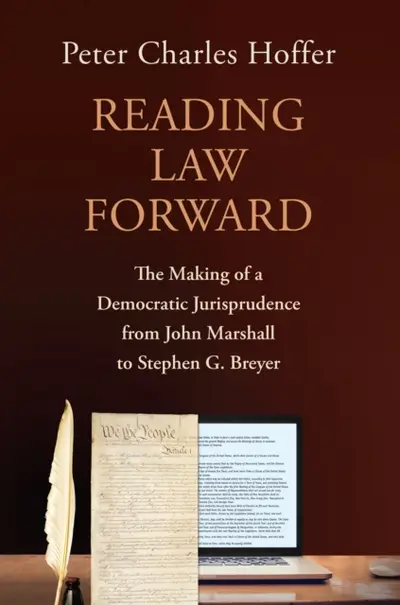
Reading Law Forward
The Making of a Democratic Jurisprudence from John Marshall to Stephen G. Breyer
Price and availability
$33.99
Available in: Andorra, Austria, Australia, Belgium, Bulgaria, Canada, Switzerland, Cyprus, Czechia, Germany, Denmark, Estonia, Spain, Finland, France, United Kingdom, Guernsey, Greece, Croatia, Hungary, Ireland, Isle of Man, Iceland, Italy, Jersey, Japan, Liechtenstein, Lithuania, Luxembourg, Latvia, Monaco, Malta, Netherlands, Norway, Poland, Portugal, Romania, Sweden, Slovenia, Slovakia, San Marino, United States, Vatican City, South Africa
Stores: US, UK, Canada, EU, Australia.
Sign in to buyThe price is re-checked by the server before payment.
For personal use under the eBook licence.
- Format
- EPUB
- DRM
- Not stated by the publisher
- Language
- English
- Publisher
- University Press of Kansas
- Published
- 6 February 2024
- ISBN
- 9780700635092
- Subjects
- Constitution: government & the state, Jurisprudence & philosophy of law, Government powers, Central / national / federal government, Jurisprudence and general issues, Government powers
About this book
In the current legal climate where everyone is an originalist, conventional wisdom suggests that judges merely find law, rather than make it. Orthodox common-law jurisprudence makes fidelity to the past the central goal and criterion. By contrast, the alternative approach, reading the law forwardwhat some call judicial pragmatism or consequentialismis viewed as heretical. Rather than mount a theoretical defense of a forward-thinking jurisprudence, legal historian Peter Charles Hoffer offers an empirical study of how this approach to constitutional interpretation actually leads to better law. Reading Law Forward looks at seven judges who exemplify this alternative jurisprudence: John Marshall, Joseph Story, Lemuel Shaw, Louis D. Brandeis, Benjamin Cardozo, William O. Douglas, and Stephen G. Breyer.In the hands of Americas leading judges, a jurisprudence of reading law forward enabled courts to respond to the challenges of changing conditions. It kept law fresh. It promoted and still promotes the growth of a democratic society, Hoffer convincingly argues.
Bibliographic data © Gardners Books Ltd.