PDF · root
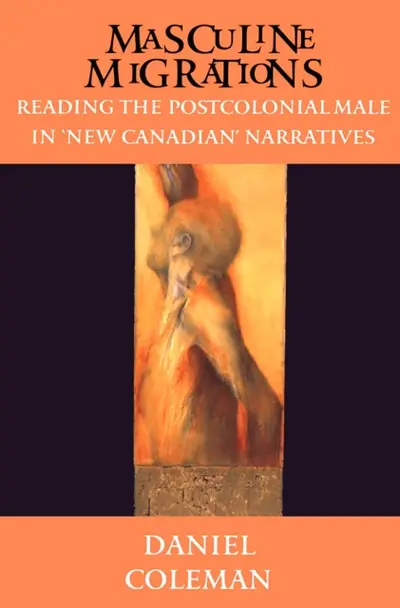
Masculine Migrations
Reading the Postcolonial Male in New Canadian Narratives
Price and availability
$66.99
Available in: Andorra, Austria, Australia, Belgium, Bulgaria, Canada, Switzerland, Cyprus, Czechia, Germany, Denmark, Estonia, Spain, Finland, France, United Kingdom, Guernsey, Greece, Croatia, Hungary, Ireland, Isle of Man, Iceland, Italy, Jersey, Japan, Liechtenstein, Lithuania, Luxembourg, Latvia, Monaco, Malta, Netherlands, Norway, Poland, Portugal, Romania, Sweden, Slovenia, Slovakia, San Marino, United States, Vatican City, South Africa
Stores: US, UK, Canada, EU, Australia.
Sign in to buyThe price is re-checked by the server before payment.
For personal use under the eBook licence.
- Format
- DRM
- Not stated by the publisher
- Language
- root
- Publisher
- University of Toronto Press
- Published
- 16 April 1998
- Pages
- 216
- ISBN
- 9781442677104
- Subjects
- American English, Literary studies: general, Literary studies: fiction, novelists & prose writers, Modern & contemporary fiction (post c 1945), Gender studies: men, 2ACBK, Literary studies: general, Literary studies: fiction, novelists and prose writers, FBA, JBSF2
About this book
This book examines the representation of masculinities in the fictions and autobiographies of some of Canada's most exciting writers, including Austin Clarke, Dany Laferrière, Neil Bissoondath, Michael Ondaatje, Ven Begamudré, and Rohinton Mistry, to show how cross-cultural migration disrupts assumed codes for masculine behaviour and practice. It is the first book-length study of masculinities in Canadian literature and also the first to discuss these prominent postcolonial writers in relation to one another. Coleman founds his study on the belief that literary endeavour is socially productive, reflecting but also participating in the production of social practices and identities, and therefore it is a work of cultural commentary as well as literary criticism. The book contends that we can produce alternative masculinities by reading masculinities that challenge our current assumptions, by reading masculinities that are themselves composed of contradictory segments rather than monolithic wholes, and by reading alternatively to elaborate a plethora of masculinities. By including fragments of the author/critic's own autobiography in the text, it also dispenses with the illusion of the all-knowing, unbiased reader. Masculine Migrations is cutting-edge scholarship and an eminently readable book, which will challenge, provoke discussion, and encourage cross-disciplinary dialogue.
Bibliographic data © Gardners Books Ltd.