EPUB · English
Blue Lake
finding Dudley Flats and the West Melbourne Swamp
Price and availability
$28.99
Available in: Andorra, Austria, Australia, Belgium, Bulgaria, Canada, Switzerland, Cyprus, Czechia, Germany, Denmark, Estonia, Spain, Finland, France, United Kingdom, Guernsey, Greece, Croatia, Hungary, Ireland, Isle of Man, Iceland, Italy, Jersey, Japan, Liechtenstein, Lithuania, Luxembourg, Latvia, Monaco, Malta, Netherlands, Norway, Poland, Portugal, Romania, Sweden, Slovenia, Slovakia, San Marino, United States, Vatican City, South Africa
Stores: US, UK, Canada, EU, Australia.
Sign in to buyThe price is re-checked by the server before payment.
For personal use under the eBook licence.
- Format
- EPUB
- DRM
- Not stated by the publisher
- Language
- English
- Publisher
- Scribe Publications Pty Ltd
- Published
- 3 September 2018
- Pages
- 400
- ISBN
- 9781925693287
- Subjects
- Victoria, Biography: general, Australasian and Pacific history, Social and cultural history, Human geography
About this book
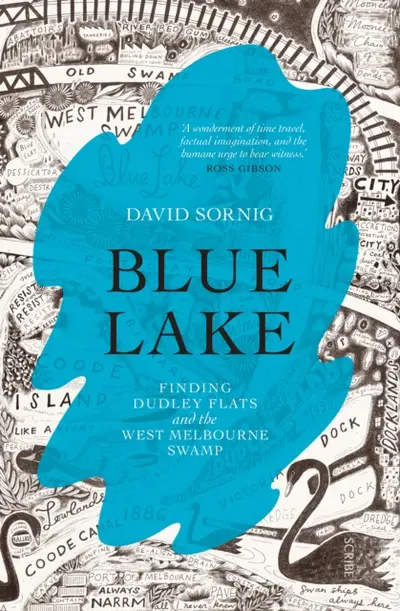
I'm here already, in the bleak, awful hour on Dudley Flats in which the final dereliction of Elsie Williams will come to pass. I'm beginning with it, so you won't be under any illusion as to how it ends.In Blue Lake, David Sornig examines how the 8km-square zone to the west of central Melbourne became the city's blind spot. Once a fertile wetland with a large blue saltwater lagoon, it passed through various incarnations: from boneyards and rubbish tips; through the Depression-era Dudley Flats shanty town; to the modern-day docks. Through it all, one thing that has persisted is its uncanny, liminal quality.As well as being a social history and a psychogeographic contemplation, Blue Lake is a biography of three specific characters: Elsie Williams, a Bendigo-born singer of Afro-Caribbean origin; Jack Peacock, the king of Dudley Flats tip-scavenging economy; and Lauder Heinrich Rogge, a German hermit who lived for decades with sixty dogs on a stranded ship. By charting the rises and falls in their individual fortunes, Sornig reveals much about the race and class divides of their times and explores questions about those strange and singular places in the urban fabric where chaos is difficult to contain.In masterful prose, Sornig reveals cracks in the colonial mythology of the ordered vision of progressive, urban Melbourne a place where identities, both personal and public, have never quite been resolved. In doing so, he encourages readers to look harder at the places they live in at the streets they walk, the buildings they enter, the empty spaces they pass and to see in them intricate layers of time and history that have been hidden from view.
Bibliographic data © Gardners Books Ltd.