PDF · English
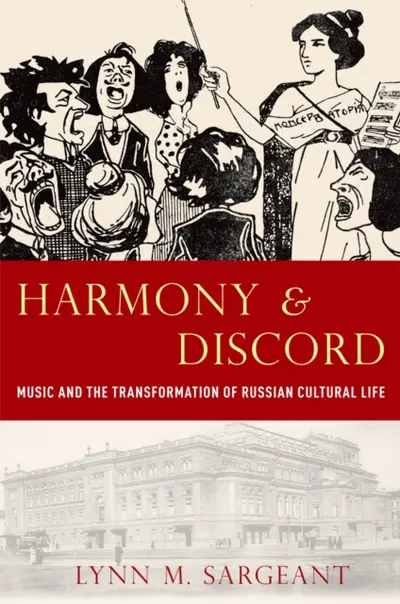
Harmony and Discord
Music and the Transformation of Russian Cultural Life
Price and availability
$64.99
Available in: Andorra, Austria, Australia, Belgium, Bulgaria, Canada, Switzerland, Cyprus, Czechia, Germany, Denmark, Estonia, Spain, Finland, France, United Kingdom, Guernsey, Greece, Croatia, Hungary, Ireland, Isle of Man, Iceland, Italy, Jersey, Japan, Liechtenstein, Lithuania, Luxembourg, Latvia, Monaco, Malta, Netherlands, Norway, Poland, Portugal, Romania, Sweden, Slovenia, Slovakia, San Marino, United States, Vatican City, South Africa
Stores: US, UK, Canada, EU, Australia.
Sign in to buyThe price is re-checked by the server before payment.
For personal use under the eBook licence.
- Format
- DRM
- Not stated by the publisher
- Language
- English
- Publisher
- Oxford University Press
- Published
- 17 November 2010
- ISBN
- 9780199780792
- Subjects
- Russia, c 1800 to c 1900, Romantic music (c 1830 to c 1900), European history, Modern history to 20th century: c 1700 to c 1900, Social & cultural history, 3MN, AVLA, NH, NHD, NHTB
About this book
Harmony and Discord: Music and the Transformation of Russian Cultural Life explores the complex development of Russian musical life during the nineteenth and early twentieth centuries. At the heart of this cultural history lies the Russian Musical Society, as both a unique driving force behind the institutionalization of music and a representative of the growing importance of voluntary associations in public life. Sustained simultaneously by private initiative and cooperative relationships with the state, the Russian Musical Society played a key role in the creation of Russia's infrastructure for music and music education. Author Lynn M. Sargeant explores the fluid nature of Russian social identity through the broad scope of musical life, including not only the "e;leading lights"e; of the era but also rank-and-file musicians, teachers, and students. Although Russian musicians longed for a secure place within the new hierarchy of professions, their social status remained ambiguous throughout the nineteenth century. Traditional reliance on serf musicians and foreigners left lasting scars that motivated musicians' efforts to obtain legal rights and social respectability. And women's increasing visibility in the musical world provoked acrimonious debates that were, at heart, efforts by male musicians to strengthen their claims to professional status by denying the legitimacy of female participation. Sargeant demonstrates that the successful development of a Russian musical infrastructure salved persistent anxieties about Russia's place vis-a-vis its European cultural competitors. Remarkably, the institutions developed by the Russian Musical Society survived the upheavals of war and revolution to become the foundation for the Soviet musical system. A wealth of historical documentation makes Harmony and Discord required reading for musicologists, sociologists and historians interested in this period, and the abundance of amusing anecdotes and the author's lucid and lively literary style make it an enjoyable history for all readers.
Bibliographic data © Gardners Books Ltd.