PDF · English
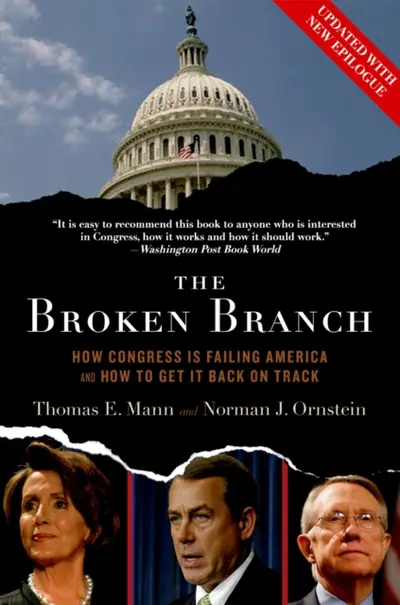
Broken Branch
How Congress Is Failing America and How to Get It Back on Track
Price and availability
$12.99
Available in: Andorra, Austria, Australia, Belgium, Bulgaria, Canada, Switzerland, Cyprus, Czechia, Germany, Denmark, Estonia, Spain, Finland, France, United Kingdom, Guernsey, Greece, Croatia, Hungary, Ireland, Isle of Man, Iceland, Italy, Jersey, Japan, Liechtenstein, Lithuania, Luxembourg, Latvia, Monaco, Malta, Netherlands, Norway, Poland, Portugal, Romania, Sweden, Slovenia, Slovakia, San Marino, United States, Vatican City, South Africa
Stores: US, UK, Canada, EU, Australia.
Sign in to buyThe price is re-checked by the server before payment.
For personal use under the eBook licence.
- Format
- DRM
- Not stated by the publisher
- Language
- English
- Publisher
- Oxford University Press
- Published
- 1 August 2006
- ISBN
- 9780198038894
- Subjects
- USA, Constitution: government & the state, Central government policies, United States of America, USA, Constitution: government and the state, Central / national / federal government policies
About this book
The Broken Branch offers both a brilliant diagnosis of the cause of Congressional decline and a much-needed blueprint for change, from two experts who understand politics and revere our institutions, but believe that Congress has become deeply dysfunctional. Mann and Ornstein, two of the nation's most renowned and judicious scholars of government and politics, bring to light the historical roots of Congress's current maladies, examining 40 years of uninterrupted Democratic control of the House and the stunning midterm election victory of 1994 that propelled Republicans into the majority in both House and Senate. The byproduct of that long and grueling but ultimately successful Republican campaign, the authors reveal, was a weakened institution bitterly divided between the parties. They highlight the dramatic shift in Congress from a highly decentralized, committee-based institution into a much more regimented one in which party increasingly trumps committee. The resultant changes in the policy process--the demise of regular order, the decline of deliberation, and the weakening of our system of checks and balances--have all compromised the role of Congress in the American Constitutional system. From tax cuts to the war against Saddam Hussein to a Medicare prescription drug benefit, the Legislative process has been bent to serve immediate presidential interests and have often resulted in poorly crafted and stealthily passed laws. Strong majority leadership in Congress, the authors conclude, led not to a vigorous exertion of congressional authority but to a general passivity in the face of executive power.
Bibliographic data © Gardners Books Ltd.