PDF · English
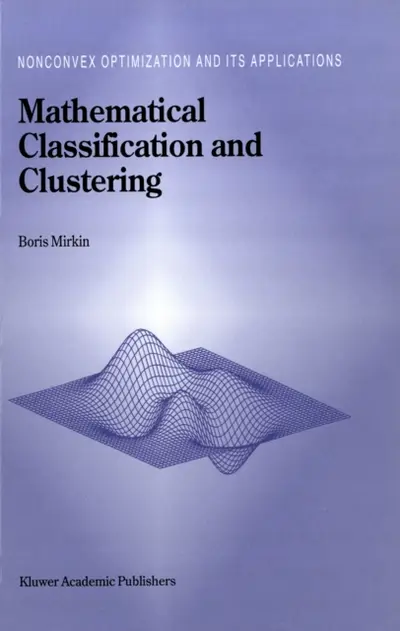
Mathematical Classification and Clustering
Price and availability
$60.99
Available in: Andorra, Austria, Australia, Belgium, Bulgaria, Canada, Switzerland, Cyprus, Czechia, Germany, Denmark, Estonia, Spain, Finland, France, United Kingdom, Guernsey, Greece, Croatia, Hungary, Ireland, Isle of Man, Iceland, Italy, Jersey, Japan, Liechtenstein, Lithuania, Luxembourg, Latvia, Monaco, Malta, Netherlands, Norway, Poland, Portugal, Romania, Sweden, Slovenia, Slovakia, San Marino, United States, Vatican City, South Africa
Stores: US, UK, Canada, EU, Australia.
Sign in to buyThe price is re-checked by the server before payment.
For personal use under the eBook licence.
- Format
- DRM
- Not stated by the publisher
- Language
- English
- Publisher
- Springer US
- Published
- 1 December 2013
- ISBN
- 9781461304579
- Subjects
- Management decision making, Operational research, Probability & statistics, Optimization, Artificial intelligence, Management decision making, Operational research, Probability and statistics, Optimization, Artificial intelligence (AI)
About this book
I am very happy to have this opportunity to present the work of Boris Mirkin, a distinguished Russian scholar in the areas of data analysis and decision making methodologies. The monograph is devoted entirely to clustering, a discipline dispersed through many theoretical and application areas, from mathematical statistics and combina- torial optimization to biology, sociology and organizational structures. It compiles an immense amount of research done to date, including many original Russian de- velopments never presented to the international community before (for instance, cluster-by-cluster versions of the K-Means method in Chapter 4 or uniform par- titioning in Chapter 5). The author's approach, approximation clustering, allows him both to systematize a great part of the discipline and to develop many in- novative methods in the framework of optimization problems. The optimization methods considered are proved to be meaningful in the contexts of data analysis and clustering. The material presented in this book is quite interesting and stimulating in paradigms, clustering and optimization. On the other hand, it has a substantial application appeal. The book will be useful both to specialists and students in the fields of data analysis and clustering as well as in biology, psychology, economics, marketing research, artificial intelligence, and other scientific disciplines. Panos Pardalos, Series Editor.
Bibliographic data © Gardners Books Ltd.