PDF · English
Why We Can't Have Nice Things
Social Media’s Influence on Fashion, Ethics, and Property
Price and availability
$32.99
Available in: Andorra, Austria, Australia, Belgium, Bulgaria, Canada, Switzerland, Cyprus, Czechia, Germany, Denmark, Estonia, Spain, Finland, France, United Kingdom, Guernsey, Greece, Croatia, Hungary, Ireland, Isle of Man, Iceland, Italy, Jersey, Japan, Liechtenstein, Lithuania, Luxembourg, Latvia, Monaco, Malta, Netherlands, Norway, Poland, Portugal, Romania, Sweden, Slovenia, Slovakia, San Marino, United States, Vatican City, South Africa
Stores: US, UK, Canada, EU, Australia.
Sign in to buyThe price is re-checked by the server before payment.
For personal use under the eBook licence.
- Format
- DRM
- Not stated by the publisher
- Language
- English
- Publisher
- Duke University Press
- Published
- 8 August 2022
- ISBN
- 9781478023210
- Subjects
- Fashion & textiles: design, Popular culture, Fashion & society, Media studies, Fashion and textile design, JBCC1, JBCC3, JBCT
About this book
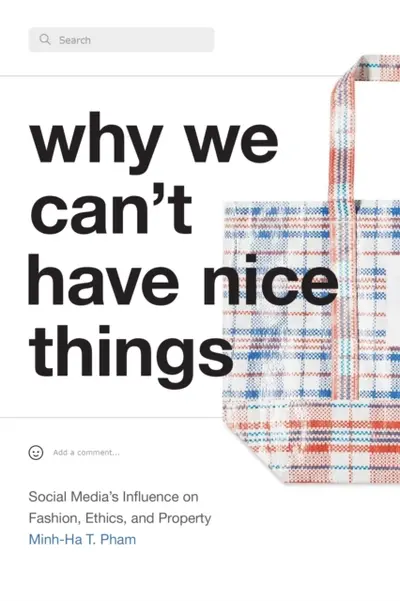
In 2016, social media users in Thailand called out the Paris-based luxury fashion house Balenciaga for copying the popular Thai "e;rainbow bag,"e; using Balenciaga's hashtags to circulate memes revealing the source of the bags' design. In Why We Can't Have Nice Things Minh-Ha T. Pham examines the way social media users monitor the fashion market for the appearance of knockoff fashion, design theft, and plagiarism. Tracing the history of fashion antipiracy efforts back to the 1930s, she foregrounds the work of policing that has been tacitly outsourced to social media. Despite the social media concern for ethical fashion and consumption and the good intentions behind design policing, Pham shows that it has ironically deepened forms of social and market inequality, as it relies on and reinforces racist and colonial norms and ideas about what constitutes copying and what counts as creativity. These struggles over ethical fashion and intellectual property, Pham demonstrates, constitute deeper struggles over the colonial legacies of cultural property in digital and global economies.
Bibliographic data © Gardners Books Ltd.