PDF · English
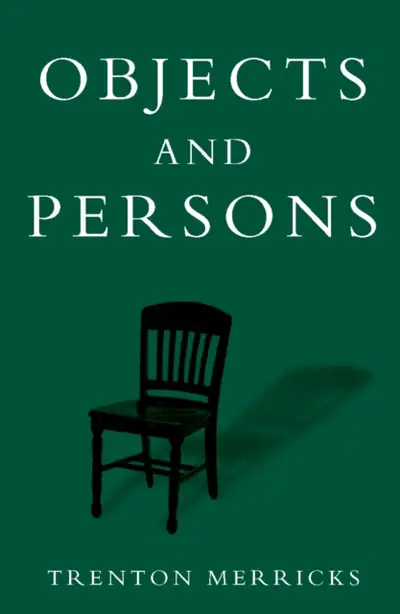
Objects and Persons
Price and availability
$62.99
Available in: Andorra, Austria, Australia, Belgium, Bulgaria, Canada, Switzerland, Cyprus, Czechia, Germany, Denmark, Estonia, Spain, Finland, France, United Kingdom, Guernsey, Greece, Croatia, Hungary, Ireland, Isle of Man, Iceland, Italy, Jersey, Japan, Liechtenstein, Lithuania, Luxembourg, Latvia, Monaco, Malta, Netherlands, Norway, Poland, Portugal, Romania, Sweden, Slovenia, Slovakia, San Marino, United States, Vatican City, South Africa
Stores: US, UK, Canada, EU, Australia.
Sign in to buyThe price is re-checked by the server before payment.
For personal use under the eBook licence.
- Format
- DRM
- Not stated by the publisher
- Language
- English
- Publisher
- Oxford University Press
- Published
- 24 May 2001
- ISBN
- 9780191529689
- Subjects
- Philosophy: metaphysics & ontology, Philosophy of mind, Philosophy: metaphysics and ontology, Philosophy of mind
About this book
There are no statues. Or rocks. Or chairs. Or stars. But there are microscopic objects arranged statuewise and rockwise and chairwise and starwise. Moreover, there are--in addition to microscopic objects arranged humanwise--composite human beings. Or so Trenton Merricks argues. The ontology of Objects and Persons is motivated, in large part, by causal considerations. One of the central ideas is that physical objects are causally non-redundant: physical objects cause things that are not wholly overdetermined by their proper parts. Merricks 'eliminates' statues and other inanimate composite macrophysical objects on the grounds that they would--if they existed--be at best completely causally redundant. Merricks defends our existence by arguing, from certain facts about mental causation, that we human beings cause things that are not overdetermined by our proper parts. A second strand of argument for Merricks's overall ontology involves a variety of philosophical puzzles, puzzles that are dealt with in illuminating and often novel ways. Many other issues are addressed along the way, including free will, the 'reduction' of a composite object to its parts, and the ways in which identity over time can "e;for practical purposes"e; be a matter of convention. Anyone working in metaphysics will enjoy this lucid and provocative book.
Bibliographic data © Gardners Books Ltd.