PDF · English
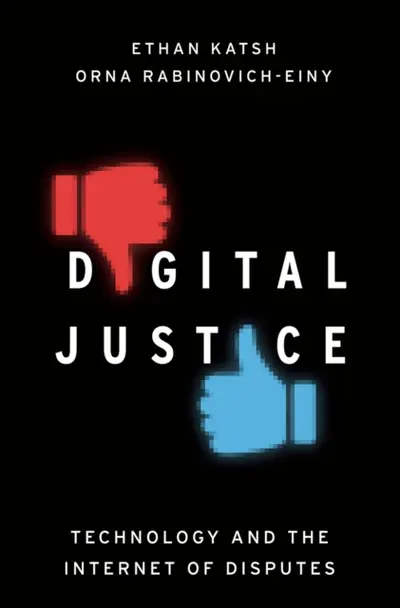
Digital Justice
Technology and the Internet of Disputes
Price and availability
$36.99
Available in: Andorra, Austria, Australia, Belgium, Bulgaria, Canada, Switzerland, Cyprus, Czechia, Germany, Denmark, Estonia, Spain, Finland, France, United Kingdom, Guernsey, Greece, Croatia, Hungary, Ireland, Isle of Man, Iceland, Italy, Jersey, Japan, Liechtenstein, Lithuania, Luxembourg, Latvia, Monaco, Malta, Netherlands, Norway, Poland, Portugal, Romania, Sweden, Slovenia, Slovakia, San Marino, United States, Vatican City, South Africa
Stores: US, UK, Canada, EU, Australia.
Sign in to buyThe price is re-checked by the server before payment.
For personal use under the eBook licence.
- Format
- DRM
- Not stated by the publisher
- Language
- English
- Publisher
- Oxford University Press
- Published
- 9 March 2017
- ISBN
- 9780190464592
- Subjects
- Courts & procedure, Regulation of legal profession, IT & Communications law, Legal systems: courts and procedures, Legal systems: regulation of legal profession, Digital, IT and Communications law
About this book
Improving access to justice has been an ongoing process, and on-demand justice should be a natural part of our increasingly on-demand society. What can we do for example when Facebook blocks our account, we're harassed on Twitter, discover that our credit report contains errors, or receive a negative review on Airbnb? How do we effectively resolve these and other such issues?Digital Justice introduces the reader to new technological tools to resolve and prevent disputes bringing dispute resolution to cyberspace, where those who would never look to a court for assistance can find help for instance via a smartphone. The authors focus particular attention on five areas that have seen great innovation as well as large volumes of disputes: ecommerce, healthcare, social media, labor, and the courts. As conflicts escalate with the increase in innovation, the authors emphasize the need for new dispute resolution processes and new ways to avoid disputes, something that has been ignored by those seeking to improve access to justice in the past.
Bibliographic data © Gardners Books Ltd.