PDF · English
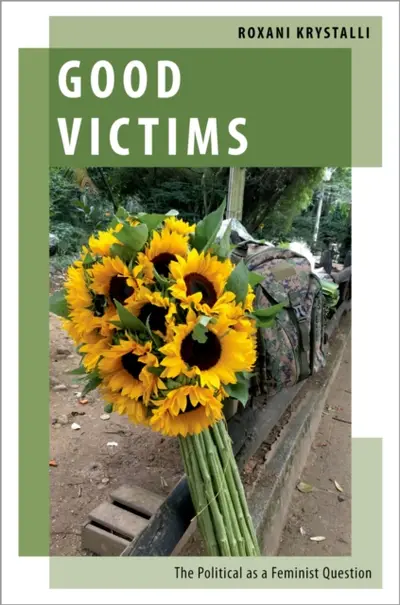
Good Victims
The Political as a Feminist Question
Price and availability
$22.99
Available in: Andorra, Austria, Australia, Belgium, Bulgaria, Canada, Switzerland, Cyprus, Czechia, Germany, Denmark, Estonia, Spain, Finland, France, United Kingdom, Guernsey, Greece, Croatia, Hungary, Ireland, Isle of Man, Iceland, Italy, Jersey, Japan, Liechtenstein, Lithuania, Luxembourg, Latvia, Monaco, Malta, Netherlands, Norway, Poland, Portugal, Romania, Sweden, Slovenia, Slovakia, San Marino, United States, Vatican City, South Africa
Stores: US, UK, Canada, EU, Australia.
Sign in to buyThe price is re-checked by the server before payment.
For personal use under the eBook licence.
- Format
- DRM
- Not stated by the publisher
- Language
- English
- Publisher
- Oxford University Press
- Published
- 23 April 2024
- ISBN
- 9780197764558
- Subjects
- Peace studies & conflict resolution, Feminism & feminist theory, Crime & criminology, International relations, GTU, JBSF11, Crime and criminology, International relations
About this book
As of 2023, over nine million Colombians have secured official recognition as victims of an armed conflict that has lasted decades. The category of "e;victim"e; is not a mere description of having suffered harm, but a political status and a potential site of power. In Good Victims, Roxani Krystalli investigates the politics of victimhood as a feminist question. Based on in-depth engagement in Colombia over the course of a decade, Krystalli argues for the possibilities of politics through, rather than in opposition to, the status of "e;victim."e; Encompassing acts of care, agency, and haunting, the politics of victimhood entangle people who identify as victims, researchers, and transitional justice professionals. Krystalli shows how victimhood becomes a pillar of reimagining the state in the wake of war, and of bringing a vision of that state into being through bureaucratic encounters. Good Victims also sheds light on the ethical and methodological dilemmas that arise when contemplating the legacies of transitional justice mechanisms.
Bibliographic data © Gardners Books Ltd.