EPUB · English
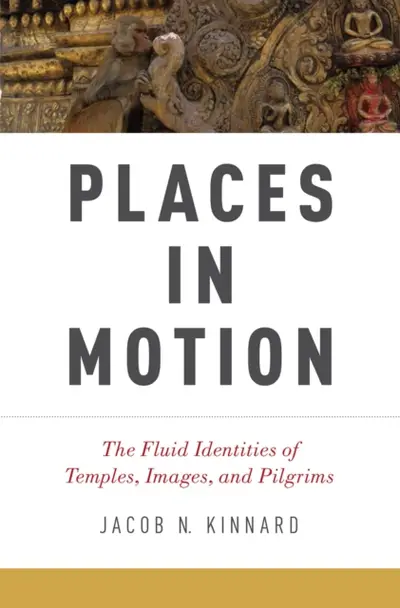
Places in Motion
The Fluid Identities of Temples, Images, and Pilgrims
Price and availability
$39.99
Available in: Andorra, Austria, Australia, Belgium, Bulgaria, Canada, Switzerland, Cyprus, Czechia, Germany, Denmark, Estonia, Spain, Finland, France, United Kingdom, Guernsey, Greece, Croatia, Hungary, Ireland, Isle of Man, Iceland, Italy, Jersey, Japan, Liechtenstein, Lithuania, Luxembourg, Latvia, Monaco, Malta, Netherlands, Norway, Poland, Portugal, Romania, Sweden, Slovenia, Slovakia, San Marino, United States, Vatican City, South Africa
Stores: US, UK, Canada, EU, Australia.
Sign in to buyThe price is re-checked by the server before payment.
For personal use under the eBook licence.
- Format
- EPUB
- DRM
- Not stated by the publisher
- Language
- English
- Publisher
- Oxford University Press
- Published
- 20 June 2014
- ISBN
- 9780199359684
- Subjects
- Comparative religion, Worship, rites & ceremonies, Social & cultural anthropology, ethnography, Social, group or collective psychology, Organizational theory & behaviour, Social and cultural anthropology, Social, group or collective psychology, Organizational theory and behaviour, QRAC, QRVJ1
About this book
Jacob Kinnard offers an in-depth examination of the complex dynamics of religiously charged places. Focusing on several important shared and contested pilgrimage places-Ground Zero and Devils Tower in the United States, Ayodhya and Bodhgaya in India, Karbala in Iraq-he poses a number of crucial questions. What and who has made these sites important, and why? How are they shared, and how and why are they contested? What is at stake in their contestation? How are the particular identities of place and space established? How are individual and collective identity intertwined with space and place?Challenging long-accepted, clean divisions of the religious world, Kinnard explores specific instances of the vibrant messiness of religious practice, the multivocality of religious objects, the fluid and hybrid dynamics of religious places, and the shifting and tangled identities of religious actors. He contends that sacred space is a constructed idea: places are not sacred in and of themselves, but are sacred because we make them sacred. As such, they are in perpetual motion, transforming themselves from moment to moment and generation to generation. Places in Motion moves comfortably across and between a variety of historical and cultural settings as well as academic disciplines, providing a deft and sensitive approach to the topic of sacred places, with awareness of political, economic, and social realities as these exist in relation to questions of identity. It is a lively and much needed critical advance in analytical reflections on sacred space and pilgrimage.
Bibliographic data © Gardners Books Ltd.