EPUB · English
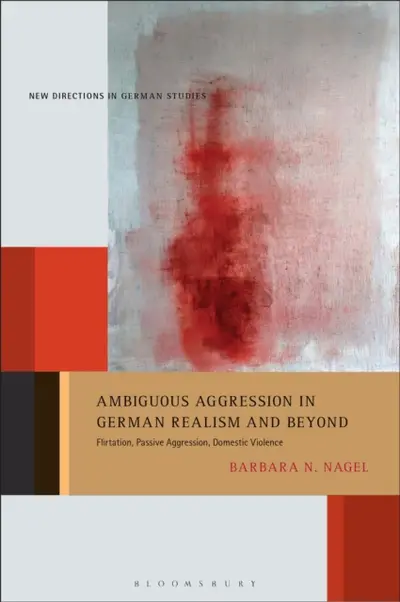
Ambiguous Aggression in German Realism and Beyond
Flirtation, Passive Aggression, Domestic Violence
Price and availability
$40.99
Available in: Andorra, Austria, Australia, Belgium, Bulgaria, Canada, Switzerland, Cyprus, Czechia, Germany, Denmark, Estonia, Spain, Finland, France, United Kingdom, Guernsey, Greece, Croatia, Hungary, Ireland, Isle of Man, Iceland, Italy, Jersey, Japan, Liechtenstein, Lithuania, Luxembourg, Latvia, Monaco, Malta, Netherlands, Norway, Poland, Portugal, Romania, Sweden, Slovenia, Slovakia, San Marino, United States, Vatican City, South Africa
Stores: US, UK, Canada, EU, Australia.
Sign in to buyThe price is re-checked by the server before payment.
For personal use under the eBook licence.
- Format
- EPUB
- DRM
- Not stated by the publisher
- Language
- English
- Publisher
- Bloomsbury Publishing (USA)
- Published
- 17 October 2019
- Pages
- 176
- ISBN
- 9781501352720
- Subjects
- Germany, German, c 1800 to c 1900, 20th century, Literary studies: general, Gender studies, gender groups, German, 3MN, 3MP, Literary studies: general, JBSF
About this book
Our main words defining emotional states suggest that we have clarity about them: expressions like "e;love,"e; "e;hatred,"e; "e;anxiety,"e; or "e;sorrow"e; seem clear enough. The reality, however, tends to be more complicated. We are often faced with gestures and utterances that are difficult to interpret; we thus find ourselves wondering about the affective force of what has just been said: "e;Was that an insult?"e; "e;Flirtation?"e; "e;Aggression?"e; Ambiguous Aggression in German Realism and Beyond looks at three interlocking forms of social violence--flirtation, passive aggression, and domestic violence. In order to understand their circulation, it traces their literary-historical genealogy in German realism and modernism--in scenes from Annette von Droste-Hulshoff, Adalbert Stifter, Theodor Storm, Theodor Fontane, Robert Walser, and Franz Kafka, covering a historical period from the middle of the 19th century to the early decades of the 20th century. Reading realist and modernist literature through 21st-century affect theory and vice versa, the analyses collected in this book show the deep literary history of our current cultural predicaments and predilections.
Bibliographic data © Gardners Books Ltd.