PDF · English
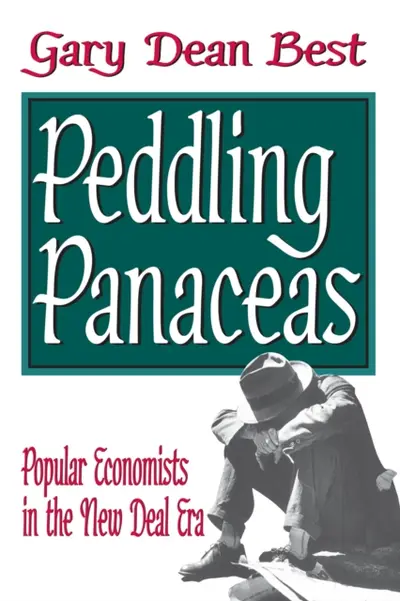
Peddling Panaceas
Popular Economists in the New Deal Era
Price and availability
$48.99
Available in: Andorra, Austria, Australia, Belgium, Bulgaria, Canada, Switzerland, Cyprus, Czechia, Germany, Denmark, Estonia, Spain, Finland, France, United Kingdom, Guernsey, Greece, Croatia, Hungary, Ireland, Isle of Man, Iceland, Italy, Jersey, Japan, Liechtenstein, Lithuania, Luxembourg, Latvia, Monaco, Malta, Netherlands, Norway, Poland, Portugal, Romania, Sweden, Slovenia, Slovakia, San Marino, United States, Vatican City, South Africa
Stores: US, UK, Canada, EU, Australia.
Sign in to buyThe price is re-checked by the server before payment.
For personal use under the eBook licence.
- Format
- DRM
- Not stated by the publisher
- Language
- English
- Publisher
- Taylor & Francis
- Published
- 5 July 2017
- ISBN
- 9781351500357
- Subjects
- USA, c 1918 to c 1939 (Inter-war period), History of the Americas, Economic theory & philosophy, Political economy, Economic history, Economics
About this book
As the Great Depression dragged on without a recovery, Americans were avid for anything that would help them to understand its causes and possible solutions. During this period, orthodox economists were largely discredited, both in the White House and among the public. Three of the most popular and influential figures of the period - Edward A. Rumely, Stuart Chase, and David Cushman Coyle - were not trained in economics. In Peddling Panaceas, Gary Dean Best analyzes their remedies for the Depression, their proposals for permanent economic reform, and their influence. Each of these men represented a principal economic faction within the New Deal. The inflationists within the New Deal found support from the Committee for the Nation, which was largely the creation of Edward Rumely. Rumely's committee was influential in the early New Deal, but largely passed into eclipse by early 1934. The planners within the New Deal were represented in popular magazines and books by Stuart Chase, who was an engineer and accountant before he began to expound on economics. An early advocate of collectivism, Chase's influence waned after the Supreme Court invalidated two early successes, the NRA and the AAA. David Cushman Coyle, a structural engineer who, like many engineers during the Depression, fancied himself an economist, may be taken as the voice of the followers of Supreme Court Justice Louis Brandeis within the New Deal. Always influential, they became more prominent after the invalidation of the NRA in 1935. These three popular economists not only influenced policy but also educated the American public about the Depression. Scarcely a month went by without an essay by Chase or Coyle in the popular magazines of the decade, and both were also prolific authors of books and pamphlets. Their views and influence help us understand the economic and political climate of the 1930s. Peddling Panaceas will be of interest to economists, cultural historians, political scientists, and sociologists.
Bibliographic data © Gardners Books Ltd.