PDF · English
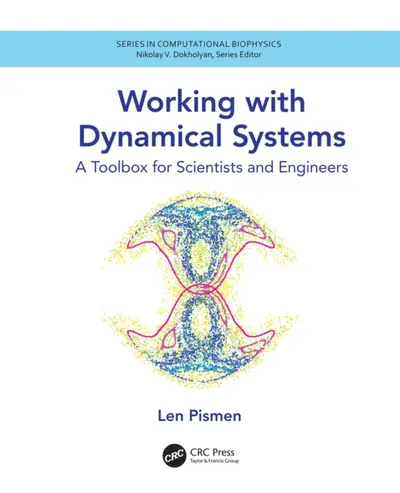
Working with Dynamical Systems
A Toolbox for Scientists and Engineers
Price and availability
$68.99
Available in: Andorra, Austria, Australia, Belgium, Bulgaria, Canada, Switzerland, Cyprus, Czechia, Germany, Denmark, Estonia, Spain, Finland, France, United Kingdom, Guernsey, Greece, Croatia, Hungary, Ireland, Isle of Man, Iceland, Italy, Jersey, Japan, Liechtenstein, Lithuania, Luxembourg, Latvia, Monaco, Malta, Netherlands, Norway, Poland, Portugal, Romania, Sweden, Slovenia, Slovakia, San Marino, United States, Vatican City, South Africa
Stores: US, UK, Canada, EU, Australia.
Sign in to buyThe price is re-checked by the server before payment.
For personal use under the eBook licence.
- Format
- DRM
- Not stated by the publisher
- Language
- English
- Publisher
- CRC Press
- Published
- 15 December 2020
- ISBN
- 9780429950155
- Subjects
- Teaching of a specific subject, Differential calculus & equations, Probability & statistics, Applied mathematics, Physics, Fluid mechanics, Dynamics & statics, Plasma physics, Mathematical physics, Mechanical engineering, Mechanics of fluids, Differential calculus and equations, Chaos theory
About this book
This book provides working tools for the study and design of nonlinear dynamical systems applicable in physics and engineering. It offers a broad-based introduction to this challenging area of study, taking an applications-oriented approach that emphasizes qualitative analysis and approximations rather than formal mathematics or simulation. The author, an internationally recognized authority in the field, makes extensive use of examples and includes executable Mathematica notebooks that may be used to generate new examples as hands-on exercises. The coverage includes discussion of mechanical models, chemical and ecological interactions, nonlinear oscillations and chaos, forcing and synchronization, spatial patterns and waves.Key Features: Written for a broad audience, avoiding dependence on mathematical formulations in favor of qualitative, constructive treatment Extensive use of physical and engineering applications Incorporates Mathematica notebooks for simulations and hands-on self-study Provides a gentle but rigorous introduction to real-world nonlinear problems Features a final chapter dedicated to applications of dynamical systems to spatial patterns The book is aimed at student and researchers in applied mathematics and mathematical modelling of physical and engineering problems. It teaches to see common features in systems of different origins, and to apply common methods of study without losing sight of complications and uncertainties related to their physical origin.
Bibliographic data © Gardners Books Ltd.