PDF · English
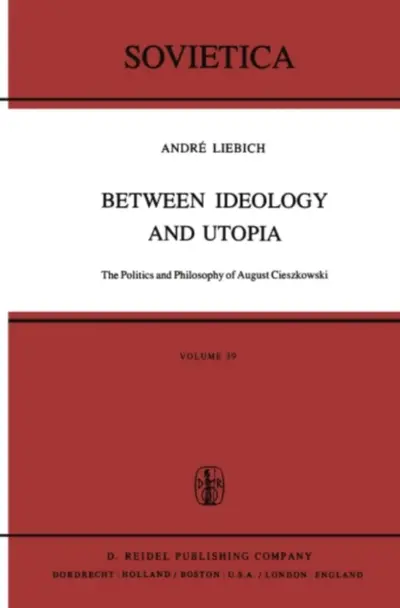
Between Ideology and Utopia
The Politics and Philosophy of August Cieszkowski
Price and availability
$60.99
Available in: Andorra, Austria, Australia, Belgium, Bulgaria, Canada, Switzerland, Cyprus, Czechia, Germany, Denmark, Estonia, Spain, Finland, France, United Kingdom, Guernsey, Greece, Croatia, Hungary, Ireland, Isle of Man, Iceland, Italy, Jersey, Japan, Liechtenstein, Lithuania, Luxembourg, Latvia, Monaco, Malta, Netherlands, Norway, Poland, Portugal, Romania, Sweden, Slovenia, Slovakia, San Marino, United States, Vatican City, South Africa
Stores: US, UK, Canada, EU, Australia.
Sign in to buyThe price is re-checked by the server before payment.
For personal use under the eBook licence.
- Format
- DRM
- Not stated by the publisher
- Language
- English
- Publisher
- Springer Netherlands
- Published
- 6 December 2012
- ISBN
- 9789400993839
- Subjects
- Cultural studies, Cultural studies
About this book
Nineteenth-century European intellectual history has given rise to such varied and abundant research that one is surprised to find certain important problems long identified and yet still relatively unexplored. Such is the case for certain aspects of the crucial transition from Hegel to Marx, for minority tendencies among French socialists and for the Messianic phenomenon, national and religious, so central to the period, particularly in Eastern Europe, and so rarely studied in detail. Certainly, these lacunae are exemplified by the absence of any com- prehensive work on August Cieszkowski whose overall contribution to the history of the period may be marginal but whose specific role in each of the areas mentioned is both significant in itself and illustrative of certain wider problems. Cieszkowski first achieved recognition as the author of the Pro- legomena zur Historiosophie in 1838. This short tract never became popular among the Berlin Hegelians for whom it was intended but it affected a number of radical intellectuals outside their circle. His next work, Gott und Palingenesie, was a defense of personal immortality against Hegelian revisionism. The following year, however, he founded as a bulwark of the Hegelian school the Philosophische Gesellschaft against external critics and internal dissolution.
Bibliographic data © Gardners Books Ltd.