PDF · English
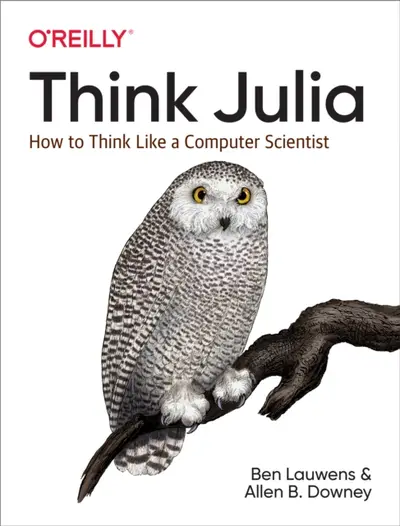
Think Julia
How to Think Like a Computer Scientist
Price and availability
$46.99
Available in: Andorra, Austria, Australia, Belgium, Bulgaria, Canada, Switzerland, Cyprus, Czechia, Germany, Denmark, Estonia, Spain, Finland, France, United Kingdom, Guernsey, Greece, Croatia, Hungary, Ireland, Isle of Man, Iceland, Italy, Jersey, Japan, Liechtenstein, Lithuania, Luxembourg, Latvia, Monaco, Malta, Netherlands, Norway, Poland, Portugal, Romania, Sweden, Slovenia, Slovakia, San Marino, United States, Vatican City, South Africa
Stores: US, UK, Canada, EU, Australia.
Sign in to buyThe price is re-checked by the server before payment.
For personal use under the eBook licence.
- Format
- DRM
- Not stated by the publisher
- Language
- English
- Publisher
- O'Reilly Media
- Published
- 5 April 2019
- ISBN
- 9781492045007
- Subjects
- Information technology: general issues, Programming & scripting languages: general, Computer science, Digital and Information technology: general topics, Programming and scripting languages: general, Computer science
About this book
If youre just learning how to program, Julia is an excellent JIT-compiled, dynamically typed language with a clean syntax. This hands-on guide uses Julia 1.0 to walk you through programming one step at a time, beginning with basic programming concepts before moving on to more advanced capabilities, such as creating new types and multiple dispatch.Designed from the beginning for high performance, Julia is a general-purpose language ideal for not only numerical analysis and computational science but also web programming and scripting. Through exercises in each chapter, youll try out programming concepts as you learn them. Think Julia is perfect for students at the high school or college level as well as self-learners and professionals who need to learn programming basics.Start with the basics, including language syntax and semanticsGet a clear definition of each programming conceptLearn about values, variables, statements, functions, and data structures in a logical progressionDiscover how to work with files and databasesUnderstand types, methods, and multiple dispatchUse debugging techniques to fix syntax, runtime, and semantic errorsExplore interface design and data structures through case studies
Bibliographic data © Gardners Books Ltd.