EPUB · English
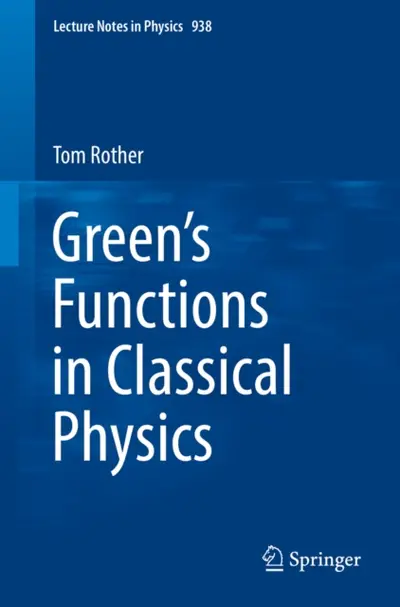
Green's Functions in Classical Physics
Price and availability
$74.99
Available in: Andorra, Austria, Australia, Belgium, Bulgaria, Canada, Switzerland, Cyprus, Czechia, Germany, Denmark, Estonia, Spain, Finland, France, United Kingdom, Guernsey, Greece, Croatia, Hungary, Ireland, Isle of Man, Iceland, Italy, Jersey, Japan, Liechtenstein, Lithuania, Luxembourg, Latvia, Monaco, Malta, Netherlands, Norway, Poland, Portugal, Romania, Sweden, Slovenia, Slovakia, San Marino, United States, Vatican City, South Africa
Stores: US, UK, Canada, EU, Australia.
Sign in to buyThe price is re-checked by the server before payment.
For personal use under the eBook licence.
- Format
- EPUB
- DRM
- Not stated by the publisher
- Language
- English
- Publisher
- Springer International Publishing
- Published
- 27 April 2017
- ISBN
- 9783319524375
- Subjects
- Astronomy, space & time, Solar system: the Sun & planets, Particle & high-energy physics, Quantum physics (quantum mechanics & quantum field theory), Mathematical physics, Astrophysics, Mechanical engineering, Solar system: the Sun and planets, Particle and high-energy physics, Mathematical / Computational / Theoretical physics, Mechanical engineering
About this book
This book presents the Green's function formalism in a basic way and demonstrates its usefulness for applications to several well-known problems in classical physics which are usually solved not by this formalism but other approaches. The book bridges the gap between applications of the Green's function formalism in quantum physics and classical physics. This book is written as an introduction for graduate students and researchers who want to become more familiar with the Green's function formalism. In 1828 George Green has published an essay that was unfortunately sunken into oblivion shortly after its publication. It was rediscovered only after several years by the later Lord Kelvin. But since this time, using Green's functions for solving partial differential equations in physics has become an important mathematical tool. While the conceptual and epistemological importance of these functions were essentially discovered and discussed in modern physics - especially in quantum field theory and quantum statistics - these aspects are rarely touched in classical physics. In doing it, this book provides an interesting and sometimes new point of view on several aspects and problems in classical physics, like the Kepler motion or the description of certain classical probability experiments in finite event spaces. A short outlook on quantum mechanical problems concludes this book.
Bibliographic data © Gardners Books Ltd.