PDF · English
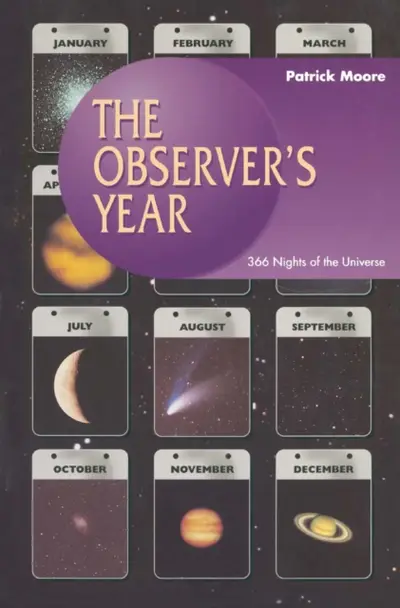
Observer's Year
366 Nights of the Universe
Price and availability
$97.99
Available in: Andorra, Austria, Australia, Belgium, Bulgaria, Canada, Switzerland, Cyprus, Czechia, Germany, Denmark, Estonia, Spain, Finland, France, United Kingdom, Guernsey, Greece, Croatia, Hungary, Ireland, Isle of Man, Iceland, Italy, Jersey, Japan, Liechtenstein, Lithuania, Luxembourg, Latvia, Monaco, Malta, Netherlands, Norway, Poland, Portugal, Romania, Sweden, Slovenia, Slovakia, San Marino, United States, Vatican City, South Africa
Stores: US, UK, Canada, EU, Australia.
Sign in to buyThe price is re-checked by the server before payment.
For personal use under the eBook licence.
- Format
- DRM
- Not stated by the publisher
- Language
- English
- Publisher
- Springer London
- Published
- 29 June 2013
- ISBN
- 9781447136132
- Subjects
- Astronomy, space & time, Astronomical observation: observatories, equipment & methods, Astrophysics, Geophysics, Popular astronomy & space, Astronomical observation: observatories, equipment and methods, Astrophysics, Geophysics
About this book
It was on ce said that 'the night sky always looks much the same'. In fact, nothing could be further from the truth. There are 365 days in each year (366 in a Leap Year!), and from an astronomical point of view no two are alike. What I aim to do, in this book, is to go through a complete year and point out some special items of interest for each night. It may be a double star, a vari- able star or a nebula; it may be a planet, or even the Moon in some particular aspect - there is plenty of variety. (Anyone unfamiliar with astronomical terms should consult the Glossary at the end ofthis book. ) Let it be said at once that you do not need a large and expensive telescope. A surprising amount can be seen with the naked eye, and binoculars give increased range; indeed, it is probably fair to say that good binoc- ulars are ideal for the beginner, and are far better than very small telescopes. Telescopes are of two types: refractors, and reflectors. A refractor collects its light by means of a glass lens known as an object-glass (OG); the light passes down the telescope tube and is brought to focus, where an image is formed and is then magnified by a second lens, termed an eyepiece.
Bibliographic data © Gardners Books Ltd.