EPUB · English
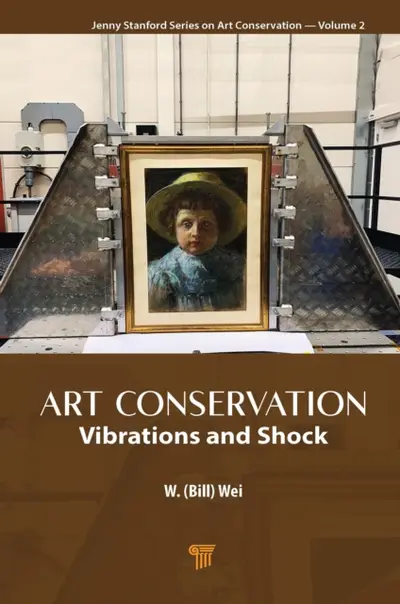
Art Conservation
Vibrations and Shock
Price and availability
$156.99
Available in: Andorra, Austria, Australia, Belgium, Bulgaria, Canada, Switzerland, Cyprus, Czechia, Germany, Denmark, Estonia, Spain, Finland, France, United Kingdom, Guernsey, Greece, Croatia, Hungary, Ireland, Isle of Man, Iceland, Italy, Jersey, Japan, Liechtenstein, Lithuania, Luxembourg, Latvia, Monaco, Malta, Netherlands, Norway, Poland, Portugal, Romania, Sweden, Slovenia, Slovakia, San Marino, United States, Vatican City, South Africa
Stores: US, UK, Canada, EU, Australia.
Sign in to buyThe price is re-checked by the server before payment.
For personal use under the eBook licence.
- Format
- EPUB
- DRM
- Not stated by the publisher
- Language
- English
- Publisher
- Taylor and Francis Group
- Published
- 9 June 2026
- ISBN
- 9781040952504
- Subjects
- Conservation, restoration & care of artworks, Museology & heritage studies, Museology and heritage studies
About this book
The effects of vibrations and shock on valuable cultural heritage objects are a major concern for conservators, collection managers, and heritage professionals. Due to a lack of training in mechanics in heritage curricula, hearsay and a fear of the unknown often play too large a role in dealing with, for example, construction projects or rock concerts in or near their collections, or loan transports. As a result, heritage professionals must search for solutions in a literature filled with confusing and often misunderstood and misused terminology, and expensive and often overdesigned advanced mitigation technologies. This second book in the Art Conservation series was therefore written to provide readers with a solid introduction to the basic concepts and terminology used in engineering for dealing with problems with vibrations and shock. Like the first book in the series, it is presented in clear, accessible language for readers without a technical background. The goal is to help them systematically analyze risks due to vibrations and shock through experience and testing, understand how vibration and shock monitoring works, and find simple and cost-effective mitigation strategies.
Bibliographic data © Gardners Books Ltd.