PDF · English
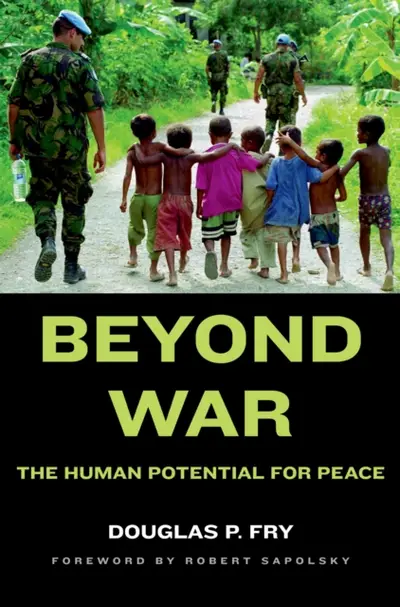
Beyond War
The Human Potential for Peace
Price and availability
$18.99
Available in: Andorra, Austria, Australia, Belgium, Bulgaria, Canada, Switzerland, Cyprus, Czechia, Germany, Denmark, Estonia, Spain, Finland, France, United Kingdom, Guernsey, Greece, Croatia, Hungary, Ireland, Isle of Man, Iceland, Italy, Jersey, Japan, Liechtenstein, Lithuania, Luxembourg, Latvia, Monaco, Malta, Netherlands, Norway, Poland, Portugal, Romania, Sweden, Slovenia, Slovakia, San Marino, United States, Vatican City, South Africa
Stores: US, UK, Canada, EU, Australia.
Sign in to buyThe price is re-checked by the server before payment.
For personal use under the eBook licence.
- Format
- DRM
- Not stated by the publisher
- Language
- English
- Publisher
- Oxford University Press
- Published
- 10 April 2009
- ISBN
- 9780199725052
- Subjects
- Peace studies & conflict resolution, Archaeology, Violence in society, Social & cultural anthropology, ethnography, Social, group or collective psychology, GTU, JBFK, Social and cultural anthropology, Social, group or collective psychology, NK
About this book
The classic opening scene of 2001, A Space Odyssey shows an ape-man wreaking havoc with humanity's first invention--a bone used as a weapon to kill a rival. It's an image that fits well with popular notions of our species as inherently violent, with the idea that humans are--and always have been--warlike by nature. But as Douglas P. Fry convincingly argues in Beyond War, the facts show that our ancient ancestors were not innately warlike--and neither are we. Fry points out that, for perhaps ninety-nine percent of our history, for well over a million years, humans lived in nomadic hunter-and-gatherer groups, egalitarian bands where generosity was highly valued and warfare was a rarity. Drawing on archaeology and fascinating fieldwork on hunter-gatherer bands from around the world, Fry debunks the idea that war is ancient and inevitable. For instance, among Aboriginal Australians--who numbered some 750,000 individuals before the arrival of Europeans, all living in hunter-gathering groups--warfare was an extreme anomaly. There was individual violence and aggression, of course, but the Aborigines had sophisticated methods of resolving disputes, controlling individual outbursts, and preventing loss of life. Fry shows that, far from being natural, warfare actually appeared quite recently along with changes in social organization and especially the rise of states. But Fry also points out that even today, when war seems ever present (at least on television), the vast majority of us live peaceful, nonviolent lives. We are not as warlike as it might seem, and if we can learn from our ancestors, we may be able to move beyond war to provide real justice and security for the people of the world. A profoundly heartening view of human nature, Beyond War offers a hopeful perspective on our species and a positive prognosis for a future without war.
Bibliographic data © Gardners Books Ltd.