PDF · English
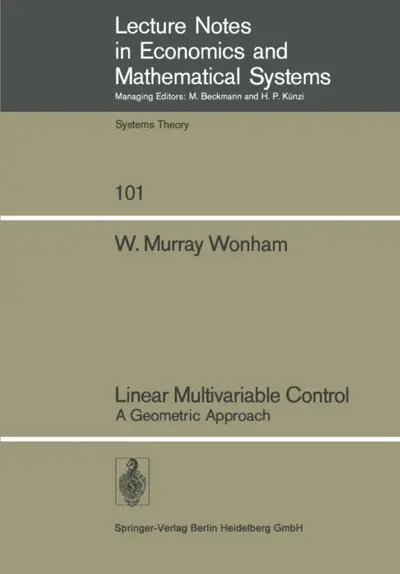
Linear Multivariable Control
A Geometric Approach
Price and availability
$97.99
Available in: Andorra, Austria, Australia, Belgium, Bulgaria, Canada, Switzerland, Cyprus, Czechia, Germany, Denmark, Estonia, Spain, Finland, France, United Kingdom, Guernsey, Greece, Croatia, Hungary, Ireland, Isle of Man, Iceland, Italy, Jersey, Japan, Liechtenstein, Lithuania, Luxembourg, Latvia, Monaco, Malta, Netherlands, Norway, Poland, Portugal, Romania, Sweden, Slovenia, Slovakia, San Marino, United States, Vatican City, South Africa
Stores: US, UK, Canada, EU, Australia.
Sign in to buyThe price is re-checked by the server before payment.
For personal use under the eBook licence.
- Format
- DRM
- Not stated by the publisher
- Language
- English
- Publisher
- Springer Berlin Heidelberg
- Published
- 21 November 2013
- ISBN
- 9783662226735
- Subjects
- Cybernetics and systems theory, Optimization
About this book
In writing this monograph my objective is to present arecent, 'geometrie' approach to the structural synthesis of multivariable control systems that are linear, time-invariant, and of finite dynamic order. The book is addressed to graduate students specializing in control, to engineering scientists engaged in control systems research and development, and to mathematicians with some previous acquaintance with control problems. The label 'geometrie' is applied for several reasons. First and obviously, the setting is linear state space and the mathematics chiefly linear algebra in abstract (geometrie) style. The basic ideas are the familiar system concepts of controllability and observability, thought of as geometrie properties of distinguished state subspaces. Indeed, the geometry was first brought in out of revulsion against the orgy of matrix manipulation which linear control theory mainly consisted of, not so long ago. But secondlyand of greater interest, the geometrie setting rather quickly suggested new methods of attacking synthesis which have proved to be intuitive and economical; they are also easily reduced to matrix arith- metic as soonas you want to compute. The essence of the 'geometrie' approach is just this: instead of looking directly for a feedback laW (say u = Fx) which would solve your synthesis problem if a solution exists, first characterize solvability as a verifiable property of some constructible state subspace, say J. Then, if all is weIl, you may calculate F from J quite easily.
Bibliographic data © Gardners Books Ltd.