EPUB · English
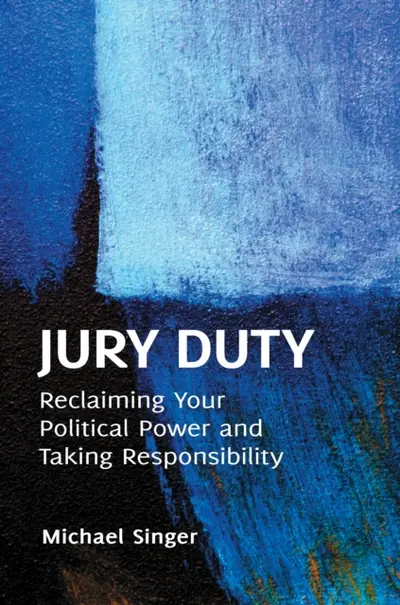
Jury Duty
Reclaiming Your Political Power and Taking Responsibility
Price and availability
$60.99
Available in: Andorra, Austria, Australia, Belgium, Bulgaria, Canada, Switzerland, Cyprus, Czechia, Germany, Denmark, Estonia, Spain, Finland, France, United Kingdom, Guernsey, Greece, Croatia, Hungary, Ireland, Isle of Man, Iceland, Italy, Jersey, Japan, Liechtenstein, Lithuania, Luxembourg, Latvia, Monaco, Malta, Netherlands, Norway, Poland, Portugal, Romania, Sweden, Slovenia, Slovakia, San Marino, United States, Vatican City, South Africa
Stores: US, UK, Canada, EU, Australia.
Sign in to buyThe price is re-checked by the server before payment.
For personal use under the eBook licence.
- Format
- EPUB
- DRM
- Not stated by the publisher
- Language
- English
- Publisher
- Bloomsbury Publishing (USA)
- Published
- 6 July 2012
- Pages
- 256
- ISBN
- 9798216107521
- Subjects
- Law, Law, citizenship & rights for the lay person, Law, Law, citizenship and rights for the lay person
About this book
Written by a legal scholar for the general reader, this book demystifies the institution of the jury and validates its political power, providing valuable insights for the more than 30 million Americans who receive a jury summons each year.Jury Duty: Reclaiming Your Political Power and Taking Responsibility presents an accessible account of the origins and development of the jury system as well as a comprehensive, stage-by-stage description of a jury trial and of the sentencing procedure in a criminal trial. The work also provides a unique estimate of the cost of the jury system, which is particularly relevant in this continuing era of budget constraints.Rejecting the justifications usually given for the jury system, the work explains how the political roles of the jury constitute the chief value of the jury system. The basis of these political roles is the unquestionable power of the jury to acquit even a guilty criminal defendant, which allows juries to prevent the enforcement of unjust laws and the imposition of unjust punishments. Accordingly, the book challenges a range of practices that the judiciary has developed to obstruct the jury's exercise of this power. Most people-even including many lawyers-remain unaware of these practices, but they undermine the value of the jury system to our society. Finally, the book offers an original, thought-provoking analysis of the responsibilities imposed on criminal trial jurors in cases of compelling injustice.
Bibliographic data © Gardners Books Ltd.