PDF · English
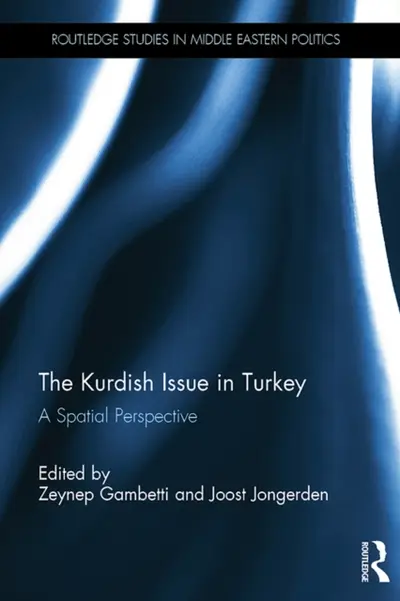
Kurdish Issue in Turkey
A Spatial Perspective
Price and availability
$63.99
Available in: Andorra, Austria, Australia, Belgium, Bulgaria, Canada, Switzerland, Cyprus, Czechia, Germany, Denmark, Estonia, Spain, Finland, France, United Kingdom, Guernsey, Greece, Croatia, Hungary, Ireland, Isle of Man, Iceland, Italy, Jersey, Japan, Liechtenstein, Lithuania, Luxembourg, Latvia, Monaco, Malta, Netherlands, Norway, Poland, Portugal, Romania, Sweden, Slovenia, Slovakia, San Marino, United States, Vatican City, South Africa
Stores: US, UK, Canada, EU, Australia.
Sign in to buyThe price is re-checked by the server before payment.
For personal use under the eBook licence.
- Format
- DRM
- Not stated by the publisher
- Language
- English
- Publisher
- Taylor & Francis
- Published
- 10 April 2015
- ISBN
- 9781317581529
- Subjects
- Ethnic minorities & multicultural studies, Türkiye / Turkey, Ethnic studies / Ethnicity, Nationalism and nationalist ideologies and movements, Settlement, urban and rural geography
About this book
This volume gives a thorough and comprehensive analysis of the Kurdish issue in Turkey from a spatial perspective that takes into account geographical variations in identity formation, exclusion and political mobilisation.Although analysis of Turkey's Kurdish issue from a spatial perspective is not new, spatial analyses are still relatively scarce. More often than not, Kurdish studies consist of time-centred work. In this book, the attention is shifted from outcome-oriented analysis of transformation in time towards a spatial analysis. The authors in this book discuss the spatial production of home, identity, work, in short, of being in the world. The contributions are based on the tacit avowal that the Kurdish question, in addition to being a question of group rights, is also one of spatial relations. By asking a different set of questions, this book examines; which spatial strategies have been employed to deal with Kurds? Which spatial strategies are developed by Kurds to deal with state, and with the neo-liberal turn? How are these strategies absorbed and what counter-strategies are developed, both in cities populated by the Kurds in south-eastern Turkey and in other regions?Emphasizing that identity or place, its particularity or uniqueness, arises from social practices and social relations, this book is essential reading for scholars and researchers working in Kurdish and Turkish Studies, Urban and Rural Studies and Politics more broadly.
Bibliographic data © Gardners Books Ltd.