EPUB · English
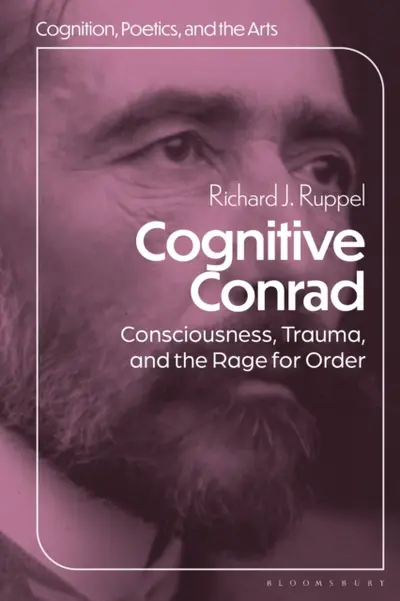
Cognitive Conrad
Consciousness, Trauma, and the Rage for Order
Price and availability
$91.99
Available in: Andorra, Austria, Australia, Belgium, Bulgaria, Canada, Switzerland, Cyprus, Czechia, Germany, Denmark, Estonia, Spain, Finland, France, United Kingdom, Guernsey, Greece, Croatia, Hungary, Ireland, Isle of Man, Iceland, Italy, Jersey, Japan, Liechtenstein, Lithuania, Luxembourg, Latvia, Monaco, Malta, Netherlands, Norway, Poland, Portugal, Romania, Sweden, Slovenia, Slovakia, San Marino, United States, Vatican City, South Africa
Stores: US, UK, Canada, EU, Australia.
Sign in to buyThe price is re-checked by the server before payment.
For personal use under the eBook licence.
- Format
- EPUB
- DRM
- Not stated by the publisher
- Language
- English
- Publisher
- Bloomsbury Publishing (USA)
- Published
- 3 September 2026
- Pages
- 180
- ISBN
- 9798216392392
- Subjects
- Literary theory, Literary studies: c 1800 to c 1900, Literary studies: from c 1900 -, Literary studies: fiction, novelists & prose writers, Cognitivism, cognitive theory, Literary theory, Literary studies: c 1800 to c 1900, Literary studies: c 1900 to c 2000, Literary studies: fiction, novelists and prose writers, Cognitivism, cognitive theory
About this book
Uncovers how Joseph Conrad's narratives reflect the cognitive studies of his day but also anticipate our own contemporary understandings of consciousness, trauma, and the human need for order. Cognitive Conrad demonstrates the interpretive power of cognitive literary studies and historicism in the most important works of Joseph Conrad. It highlights how Conrad's fiction reflects the complexities of human consciousness, trauma, and the relentless human drive to impose a coherent form on a world that, ultimately, lacks any dependable order independent of individual, human constructions. Through a detailed examination of Conrad's characters and their psychological landscapes - in a wide range of fiction, such as Lord Jim, Under Western Eyes, and various short stories - Richard J. Ruppel reveals how the novelist anticipated modern cognitive theories and the science of trauma. He also discusses the profound connections between Conrad's fiction and the work of 19th-century scientists like Hermann Helmholtz, who influenced Conrad's portrayal of perception and consciousness. Cognitive Conrad asserts the power of the arts and humanities to supplement and correct the sciences, which most often look to generalize and categorize. It argues that one key role of the arts - often articulated poignantly in Conrad's greatest work - is to highlight the anomalous, to champion the peculiar.
Bibliographic data © Gardners Books Ltd.