PDF · English
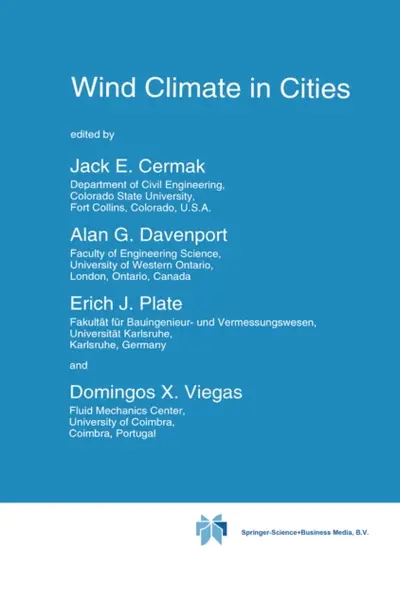
Wind Climate in Cities
Price and availability
$607.99
Available in: Andorra, Austria, Australia, Belgium, Bulgaria, Canada, Switzerland, Cyprus, Czechia, Germany, Denmark, Estonia, Spain, Finland, France, United Kingdom, Guernsey, Greece, Croatia, Hungary, Ireland, Isle of Man, Iceland, Italy, Jersey, Japan, Liechtenstein, Lithuania, Luxembourg, Latvia, Monaco, Malta, Netherlands, Norway, Poland, Portugal, Romania, Sweden, Slovenia, Slovakia, San Marino, United States, Vatican City, South Africa
Stores: US, UK, Canada, EU, Australia.
Sign in to buyThe price is re-checked by the server before payment.
For personal use under the eBook licence.
- Format
- DRM
- Not stated by the publisher
- Language
- English
- Publisher
- Springer Netherlands
- Published
- 29 June 2013
- ISBN
- 9789401736862
- Subjects
- Oceanography (seas), Meteorology & climatology, Pollution & threats to the environment, Civil engineering, surveying & building, Meteorology and climatology, Pollution and threats to the environment, Civil engineering, surveying and building
About this book
If one surveys the development of wind engineering, one comes to the conclusion that the challenge of urban climatology is one of the most important remaining tasks for the wind engineers. But what distinguishes wind engineering in urban areas from conventional wind engineering? Principally, the fact that the effects studied are usually unique to a particular situation, requiring consideration of the surroundings of the buildings. In the past, modelling criteria have been developed that make it possible to solve environmental problems with great confidence, and studies validated the models: at least in a neutrally stratified atmosphere. The approach adopted in the book is that of applied fluid mechanics, since this forms the basis for the evaluation of the urban wind field. Variables for air quality or loads are problem specific, or even random, and methods for studying them are based on risk analysis, which is also presented. Criteria are developed for a systematic approach to urban wind engineering problems, including parameter studies. The five sections of the book are: Fundamentals of urban boundary layer and dispersion; Forces on complex structures in built-up areas; Air pollution in cities; Numerical solution techniques; and Posters. A subject index is included.
Bibliographic data © Gardners Books Ltd.