PDF · English
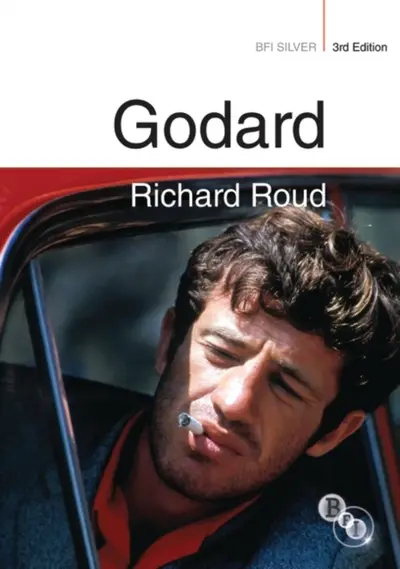
Godard
Price and availability
$36.99
Available in: Andorra, Austria, Australia, Belgium, Bulgaria, Canada, Switzerland, Cyprus, Czechia, Germany, Denmark, Estonia, Spain, Finland, France, United Kingdom, Guernsey, Greece, Croatia, Hungary, Ireland, Isle of Man, Iceland, Italy, Jersey, Japan, Liechtenstein, Lithuania, Luxembourg, Latvia, Monaco, Malta, Netherlands, Norway, Poland, Portugal, Romania, Sweden, Slovenia, Slovakia, San Marino, United States, Vatican City, South Africa
Stores: US, UK, Canada, EU, Australia.
Sign in to buyThe price is re-checked by the server before payment.
For personal use under the eBook licence.
- Format
- DRM
- Not stated by the publisher
- Language
- English
- Publisher
- Bloomsbury Publishing
- Published
- 16 September 2010
- Pages
- 264
- ISBN
- 9781844575619
- Subjects
- Films, cinema, Film theory & criticism, Individual film directors, film-makers, ATF, ATFA, ATFB
About this book
Richard Roud's Godard, first published in 1967 as 'Number One' in the seminal Cinema One series, was the first monograph on the great film-maker to be published in English, and one that reveals a unique intimacy between the author and his subject. Roud's provocative and far-reaching analysis shows an intuitive understanding of the aesthetic, intellectual and political context in which Godard worked, paying particular attention to his 'political' cinema, including the ferocious masterpiece Weekend (1967).In his foreword to this reissue, Michael Temple provides an overview of film criticism on Godard, arguing that, more than forty years since its publication, Roud's book remains at the forefront of writings on the director. Temple pinpoints how Roud was uniquely placed as a contemporary of Godard's to follow the film-maker's career from one explosive film to the next, charting the course of the Godardian star even as Roud's own career as a critic and festival programmer was unfolding. He contends that Roud's study was 'a pure product and a faithful reflection of a certain tendency in British film culture at the end of the 1960s: cin phile, progressive, European, intellectual, metropolitan.' For Temple, Roud's work remains a lucid summary of what Godard had already achieved by the end of the 1960s, and provides a suggestive model of cultural criticism with which to approach subsequent aspects of Godard's multimedia artistic adventure.
Bibliographic data © Gardners Books Ltd.