EPUB · English
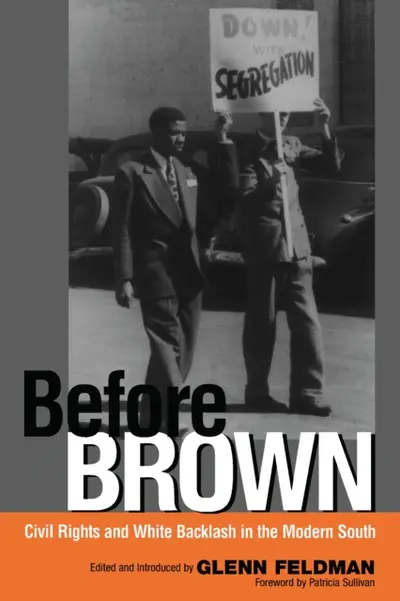
Before Brown
Civil Rights and White Backlash in the Modern South
Price and availability
$40.99
Available in: Andorra, Austria, Australia, Belgium, Bulgaria, Canada, Switzerland, Cyprus, Czechia, Germany, Denmark, Estonia, Spain, Finland, France, United Kingdom, Guernsey, Greece, Croatia, Hungary, Ireland, Isle of Man, Iceland, Italy, Jersey, Japan, Liechtenstein, Lithuania, Luxembourg, Latvia, Monaco, Malta, Netherlands, Norway, Poland, Portugal, Romania, Sweden, Slovenia, Slovakia, San Marino, United States, Vatican City, South Africa
Stores: US, UK, Canada, EU, Australia.
Sign in to buyThe price is re-checked by the server before payment.
For personal use under the eBook licence.
- Format
- EPUB
- DRM
- Not stated by the publisher
- Language
- English
- Publisher
- University of Alabama Press
- Published
- 21 October 2015
- ISBN
- 9780817390334
- Subjects
- USA, Southeastern & South Atlantic states, History, History of the Americas, Black & Asian studies, Human rights, Civil rights & citizenship, Ethnic studies / Ethnicity, Human rights, civil rights, History, History of the Americas
About this book
Details the ferment in civil rights that took place across the South before the momentous Brown vs. Board of Education decision in 1954 This collection refutes the notion that the movement began with the Supreme Court decision, and suggests, rather, that the movement originated in the 1930s and earlier, spurred by the Great Depression and, later, World War II-events that would radically shape the course of politics in the South and the nation into the next century. This work explores the growth of the movement through its various manifestations-the activities of politicians, civil rights leaders, religious figures, labor unionists, and grass-roots activists-throughout the 1940s and 1950s. It discusses the critical leadership roles played by women and offers a new perspective on the relationship between the NAACP and the Communist Party. Before Brown shows clearly that, as the drive toward racial equality advanced and national political attitudes shifted, the validity of white supremacy came increasingly into question. Institutionalized racism in the South had always offered white citizens material advantages by preserving their economic superiority and making them feel part of a privileged class. When these rewards were threatened by the civil rights movement, a white backlash occurred.
Bibliographic data © Gardners Books Ltd.