EPUB · English
Empty Place
Democracy and Public Space
Price and availability
$83.99
Available in: Andorra, Austria, Australia, Belgium, Bulgaria, Canada, Switzerland, Cyprus, Czechia, Germany, Denmark, Estonia, Spain, Finland, France, United Kingdom, Guernsey, Greece, Croatia, Hungary, Ireland, Isle of Man, Iceland, Italy, Jersey, Japan, Liechtenstein, Lithuania, Luxembourg, Latvia, Monaco, Malta, Netherlands, Norway, Poland, Portugal, Romania, Sweden, Slovenia, Slovakia, San Marino, United States, Vatican City, South Africa
Stores: US, UK, Canada, EU, Australia.
Sign in to buyThe price is re-checked by the server before payment.
For personal use under the eBook licence.
- Format
- EPUB
- DRM
- Not stated by the publisher
- Language
- English
- Publisher
- Taylor & Francis
- Published
- 17 July 2014
- ISBN
- 9781317916215
- Subjects
- Landscape art & architecture, City & town planning - architectural aspects, Urban & municipal planning, Civil engineering, surveying & building, London, Greater London, Architecture: professional practice, Political science and theory, Urban and municipal planning and policy
About this book
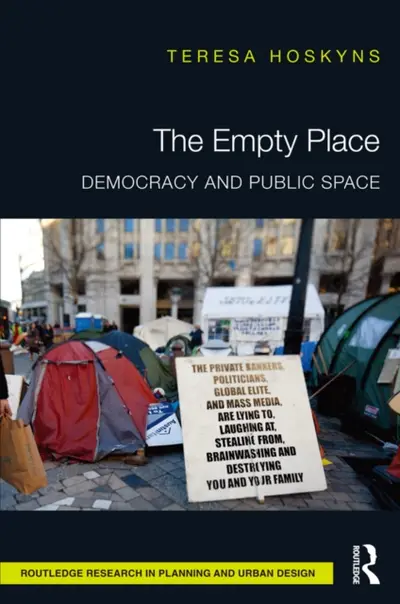
In The Empty Place: Democracy and Public Space Teresa Hoskyns explores the relationship of public space to democracy by relating different theories of democracy in political philosophy to spatial theory and spatial and political practice. Establishing the theoretical basis for the study of public space, Hoskyns examines the rise of representative democracy and investigates contemporary theories for the future of democracy, focusing on the Chantal Mouffe's agonistic model and the civil society model of Jurgen Habermas. She argues that these models of participatory democracy can co-exist and are necessarily spatial. The book then provides diverse perspectives on how the role of physical public space is articulated through three modes of participatory spatial practice. The first focuses on issues of participation in architectural practice through a set of projects exploring the 'open spaces' of a postwar housing estate in Euston. The second examines the role of space in the construction of democratic identity through a feminist architecture/art collective, producing space through writing, performance and events. The third explores participatory political democratic practice through social forums at global, European and city levels. Hoskyns concludes that participatory democracy requires a conception of public space as the empty place, allowing different models and practices of democracy to co-exist.
Bibliographic data © Gardners Books Ltd.