PDF · English
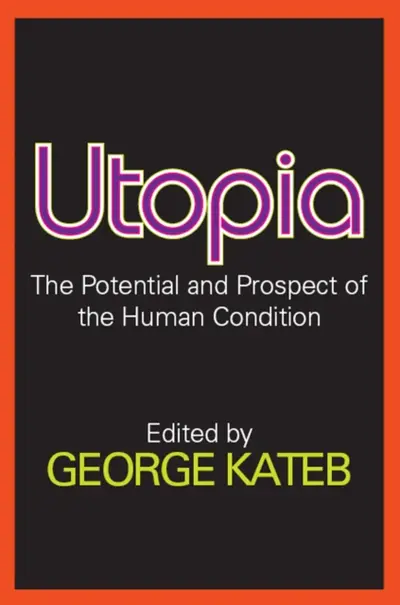
Utopia
The Potential and Prospect of the Human Condition
Price and availability
$72.99
Available in: Andorra, Austria, Australia, Belgium, Bulgaria, Canada, Switzerland, Cyprus, Czechia, Germany, Denmark, Estonia, Spain, Finland, France, United Kingdom, Guernsey, Greece, Croatia, Hungary, Ireland, Isle of Man, Iceland, Italy, Jersey, Japan, Liechtenstein, Lithuania, Luxembourg, Latvia, Monaco, Malta, Netherlands, Norway, Poland, Portugal, Romania, Sweden, Slovenia, Slovakia, San Marino, United States, Vatican City, South Africa
Stores: US, UK, Canada, EU, Australia.
Sign in to buyThe price is re-checked by the server before payment.
For personal use under the eBook licence.
- Format
- DRM
- Not stated by the publisher
- Language
- English
- Publisher
- Taylor & Francis
- Published
- 29 September 2017
- ISBN
- 9781351300391
- Subjects
- Social theory, Politics & government, Political science & theory, Political science and theory, Political ideologies and movements, Social and political philosophy
About this book
Amid the twentieth century's seemingly overwhelming problems, some thinkers dared to envisage a world order governed by utopian proposals that would eliminate--or at least alleviate--the evils of society and secure positive advantages for all human beings. Others found this utopian optimism a hopeless fantasy and predicted a utopian order only repressiveness, boredom, and the impoverishment of human experience. The unique gathering of articles in Utopia vividly demonstrates the tension existing between utopian ideas and their proponents and the severe criticism of their adversaries.Among utopia's enthusiastic supporters, B. F. Skinner outlines the educational practices needed to sustain his concept of utopia, while Margaret Mead sets forth a bold defense of utopian vision in her article "e;Towards More Vivid Utopias."e; In active opposition to modern utopian idealism, Ralf Dahrendorf, the prominent German sociologist and politician, compares utopia with a cemetery and criticizes its fixed and uneventful life, and J. L. Talmon predicts that, since utopianism postulates absolute social cohesion, there is no escape from dictatorship in the utopian design. Still another alternative is offered by Zbigniew Brzezinski, who bases his futurist ideology on the trends of technology in the advanced countries of the world, especially the United States. He sees in the conscious application of technical-scientific rationality by an intellectual elite the method by which the promises of modern knowledge can be made good.Underscoring the fact that the utopian tradition can make us look at the real world with new eyes, George Kateb, the editor of Utopia, clarifies the terms of this long-standing debate and offers a thorough analysis of the "e;strong utopian impetus to save the world from as much of its confusion and disorder as possible."e; The work is an argument neither for utopian or anti-utopian visions. Rather it shows the possibilities of political norms in advancing the human condition in open societies.
Bibliographic data © Gardners Books Ltd.