PDF · English
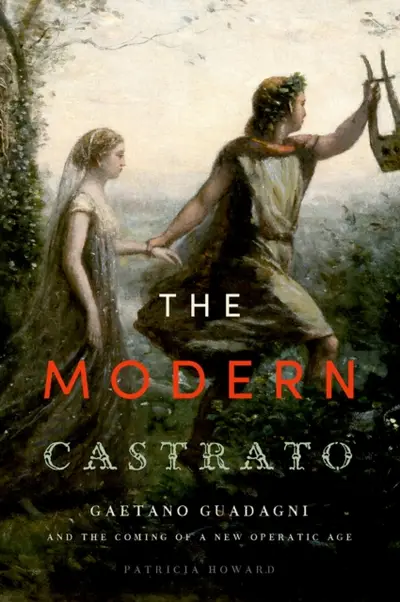
Modern Castrato
Gaetano Guadagni and the Coming of a New Operatic Age
Price and availability
$51.99
Available in: Andorra, Austria, Australia, Belgium, Bulgaria, Canada, Switzerland, Cyprus, Czechia, Germany, Denmark, Estonia, Spain, Finland, France, United Kingdom, Guernsey, Greece, Croatia, Hungary, Ireland, Isle of Man, Iceland, Italy, Jersey, Japan, Liechtenstein, Lithuania, Luxembourg, Latvia, Monaco, Malta, Netherlands, Norway, Poland, Portugal, Romania, Sweden, Slovenia, Slovakia, San Marino, United States, Vatican City, South Africa
Stores: US, UK, Canada, EU, Australia.
Sign in to buyThe price is re-checked by the server before payment.
For personal use under the eBook licence.
- Format
- DRM
- Not stated by the publisher
- Language
- English
- Publisher
- Oxford University Press
- Published
- 1 May 2014
- ISBN
- 9780199365210
- Subjects
- Baroque music (c 1600 to c 1750), Opera, Individual composers & musicians, specific bands & groups, Biography: arts & entertainment, AVLA, AVLF, AVN, DNBF
About this book
The Modern Castrato: Gaetano Guadagni and the Coming of a New Operatic Age chronicles the career of the most significant castrato of the second half of the eighteenth-century. Through a coincidence of time and place, Gaetano Guadagni was on the forefront of the heroic opera reform, and many forward-thinking composers of the age created roles for him. Author Patricia Howard reveals that Guadagni may have been the only singer of the time fully able to understand the demands and opportunities of this reform, as well to possess the intelligence and self-knowledge to realize that it suited his skills, limitations and temperament perfectly--making him the first castrato to embrace the concepts of modern singing. The first full-length biography of this outstanding singer, The Modern Castrato illuminates the everyday lives of eighteenth-century singers while spotlighting the historic high points of the century. Most famous for his creation of the role of Orpheus in Gluck's Orfeo ed Euridice, his career ranged widely and brought him into contact with many progressives theorists and composers such as Traetta, Jommelli, and Bertoni. Howard's focus on the development of Guadagni's career pauses on essential, related topics along the way, such as the castrato in society, the eighteenth-century revolution in acting, and the remarkable evidence for Guadagni's marionette theater. Howard also assesses Guadagni's surviving compositions, which give new insight into the quality and character of his voice as well as his technical and expressive abilities. The Modern Castrato is an engaging narrative that will prove essential reading for opera lovers and scholars of eighteenth-century music.
Bibliographic data © Gardners Books Ltd.