PDF · English
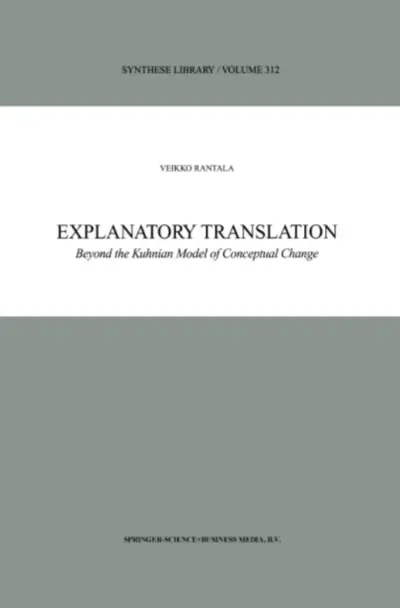
Explanatory Translation
Beyond the Kuhnian Model of Conceptual Change
Price and availability
$120.99
Available in: Andorra, Austria, Australia, Belgium, Bulgaria, Canada, Switzerland, Cyprus, Czechia, Germany, Denmark, Estonia, Spain, Finland, France, United Kingdom, Guernsey, Greece, Croatia, Hungary, Ireland, Isle of Man, Iceland, Italy, Jersey, Japan, Liechtenstein, Lithuania, Luxembourg, Latvia, Monaco, Malta, Netherlands, Norway, Poland, Portugal, Romania, Sweden, Slovenia, Slovakia, San Marino, United States, Vatican City, South Africa
Stores: US, UK, Canada, EU, Australia.
Sign in to buyThe price is re-checked by the server before payment.
For personal use under the eBook licence.
- Format
- DRM
- Not stated by the publisher
- Language
- English
- Publisher
- Springer Netherlands
- Published
- 11 November 2013
- ISBN
- 9789401715218
- Subjects
- Philosophy of science, Philosophy of language, Philosophy of science, Mathematical / Computational / Theoretical physics, Philosophy: logic, Artificial intelligence (AI)
About this book
In this book, Veikko Rantala makes a systematic attempt to understand cognitive characteristics of translation by bringing its logical, pragmatic and hermeneutic features together and examining a number of scientific, logical, and philosophical applications. The notion of translation investigated here is called explanatory, but it is not a translation in the standard sense of the word since it admits of conceptual change. Such translations can take various degrees of precision, and therefore they can occur in contexts of different kinds: from everyday discourse to literary texts to scientific change. The book generalizes some earlier approaches to translation, especially the one presented in David Pearce's monograph Roads to Commensurability. Rantala argues that the notion has something in common with Thomas Kuhn's earlier conception of scientific change and his views of language learning, but it can be used to go beyond Kuhn's well-known ideas and challenge his criticism concerning the import of the correspondence relation.
Bibliographic data © Gardners Books Ltd.