PDF · English
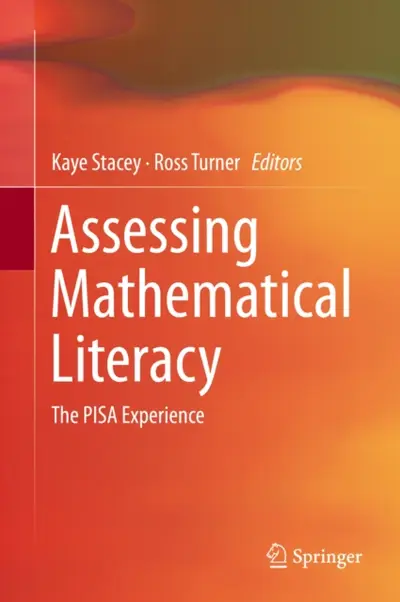
Assessing Mathematical Literacy
The PISA Experience
Price and availability
$120.99
Available in: Andorra, Austria, Australia, Belgium, Bulgaria, Canada, Switzerland, Cyprus, Czechia, Germany, Denmark, Estonia, Spain, Finland, France, United Kingdom, Guernsey, Greece, Croatia, Hungary, Ireland, Isle of Man, Iceland, Italy, Jersey, Japan, Liechtenstein, Lithuania, Luxembourg, Latvia, Monaco, Malta, Netherlands, Norway, Poland, Portugal, Romania, Sweden, Slovenia, Slovakia, San Marino, United States, Vatican City, South Africa
Stores: US, UK, Canada, EU, Australia.
Sign in to buyThe price is re-checked by the server before payment.
For personal use under the eBook licence.
- Format
- DRM
- Not stated by the publisher
- Language
- English
- Publisher
- Springer International Publishing
- Published
- 3 November 2014
- ISBN
- 9783319101217
- Subjects
- Educational strategies & policy, Examinations & assessment, Teaching of a specific subject, Mathematics, Education: examinations and assessment, Educational strategies and policy, Teaching of a specific subject, Mathematics
About this book
This book describes the design, development, delivery and impact of the mathematics assessment for the OECD Programme for International Student Assessment (PISA). First, the origins of PISA's concept of mathematical literacy are discussed, highlighting the underlying themes of mathematics as preparation for life after school and mathematical modelling of the real world, and clarifying PISA's position within this part of the mathematics education territory. The PISA mathematics framework is introduced as a significant milestone in the development and dissemination of these ideas. The underlying mathematical competencies on which mathematical literacy so strongly depends are described, along with a scheme to use them in item creation and analysis. The development and implementation of the PISA survey and the consequences for the outcomes are thoroughly discussed. Different kinds of items for both paper-based and computer-based PISA surveys are exemplified by many publicly released items along with details of scoring. The novel survey of the opportunity students have had to learn the mathematics promoted through PISA is explained. The book concludes by surveying international impact. It presents viewpoints of mathematics educators on how PISA and its constituent ideas and methods have influenced teaching and learning practices, curriculum arrangements, assessment practices, and the educational debate more generally in fourteen countries.
Bibliographic data © Gardners Books Ltd.