EPUB · English
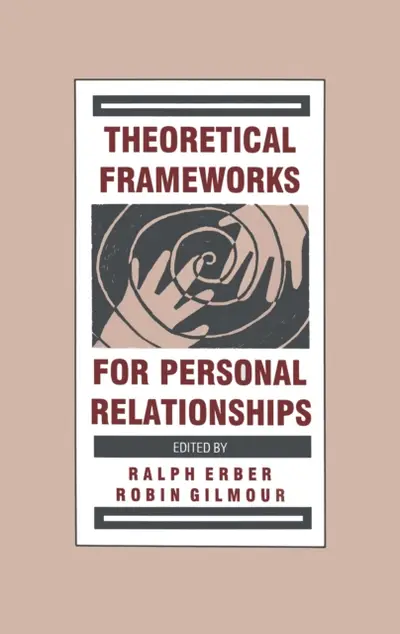
Theoretical Frameworks for Personal Relationships
Price and availability
$75.99
Available in: Andorra, Austria, Australia, Belgium, Bulgaria, Canada, Switzerland, Cyprus, Czechia, Germany, Denmark, Estonia, Spain, Finland, France, United Kingdom, Guernsey, Greece, Croatia, Hungary, Ireland, Isle of Man, Iceland, Italy, Jersey, Japan, Liechtenstein, Lithuania, Luxembourg, Latvia, Monaco, Malta, Netherlands, Norway, Poland, Portugal, Romania, Sweden, Slovenia, Slovakia, San Marino, United States, Vatican City, South Africa
Stores: US, UK, Canada, EU, Australia.
Sign in to buyThe price is re-checked by the server before payment.
For personal use under the eBook licence.
- Format
- EPUB
- DRM
- Not stated by the publisher
- Language
- English
- Publisher
- Taylor & Francis
- Published
- 17 June 2013
- ISBN
- 9781134754533
- Subjects
- Sociology: family & relationships, Psychology, Social, group or collective psychology, The self, ego, identity, personality, Psychotherapy, Child, developmental and lifespan psychology, Couple and Family psychology, Interpersonal communication and skills
About this book
The past two decades have seen a tremendous increase in research and scholarship devoted to personal relationships. From rather scattered beginnings a recognizable and recognized field has emerged, whose strength and health is reflected in a wide array of indicators. The editors contend that while the vigor of the field is often shown in the diversity and innovation of its research, it is in the theoretical domain that they find evidence of a real coming of age. This volume provides grounds for arguing that the diversity of theorizing is particularly healthy at this point. The reader will notice that there is some diversity in terms of how much theory and research is contained in each chapter -- some are purely theoretical; others are complemented by original pieces of empirical research. The editors and contributors are from different countries -- another way in which the diversity of this book manifests itself. The variety of the frameworks presented are seen as a strength, as building on established strengths elsewhere to feed into relationship research and enhance its vitality. Each chapter makes its own contribution to thinking and research about personal relationships. As a group they add to an exciting collection that not only reflects a richness of conceptual backing, but also a wide range of usable theoretical structures.
Bibliographic data © Gardners Books Ltd.