PDF · English
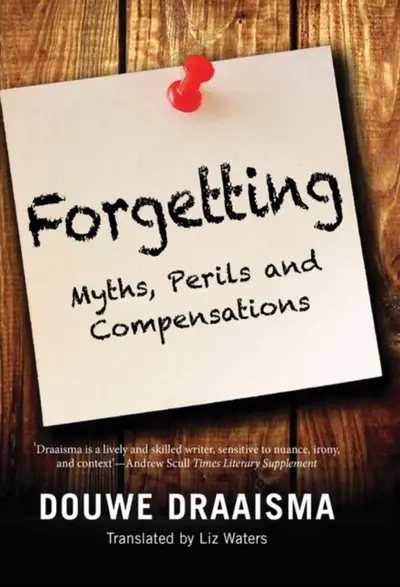
Forgetting
Myths, Perils and Compensations
Price and availability
$20.99
Available in: Andorra, Austria, Australia, Belgium, Bulgaria, Canada, Switzerland, Cyprus, Czechia, Germany, Denmark, Estonia, Spain, Finland, France, United Kingdom, Guernsey, Greece, Croatia, Hungary, Ireland, Isle of Man, Iceland, Italy, Jersey, Japan, Liechtenstein, Lithuania, Luxembourg, Latvia, Monaco, Malta, Netherlands, Norway, Poland, Portugal, Romania, Sweden, Slovenia, Slovakia, San Marino, United States, Vatican City, South Africa
Stores: US, UK, Canada, EU, Australia.
Sign in to buyThe price is re-checked by the server before payment.
For personal use under the eBook licence.
- Format
- DRM
- Not stated by the publisher
- Language
- English
- Publisher
- Yale University Press
- Published
- 1 March 2015
- ISBN
- 9780300213959
- Subjects
- Cognition & cognitive psychology, Memory, The self, ego, identity, personality, Popular psychology, Cognition and cognitive psychology, Psychology: the self, ego, identity, personality
About this book
Does forgetting signal a failing mind? What can be done to ward off forgetfulness? Is there an upside to forgetting?In his highly praised book The Nostalgia Factory, renowned memory scholar Douwe Draaisma explored the puzzling logic of memory in later life with humor and deep insight. In this compelling new book he turns to the "e;miracle"e; of forgetting. Far from being a defect that may indicate Alzheimer's or another form of dementia, Draaisma claims, forgetting is one of memory's crucial capacities. In fact, forgetting is essential. Weaving together an engaging array of literary, historical, and scientific sources, the author considers forgetting from every angle. He pierces false cliches and asks important questions: Is a forgotten memory lost forever? What makes a colleague remember an idea but forget that it was yours? Draaisma explores "e;first memories"e; of young children, how experiences are translated into memory, the controversies over repression and "e;recovered"e; memories, and weird examples of memory dysfunction. He movingly examines the impact on personal memories when a hidden truth comes to light. In a persuasive conclusion the author advocates the undervalued practice of "e;the art of forgetting"e; a set of techniques that assist in erasing memories, thereby preserving valuable relationships and encouraging personal contentment.
Bibliographic data © Gardners Books Ltd.