PDF · English
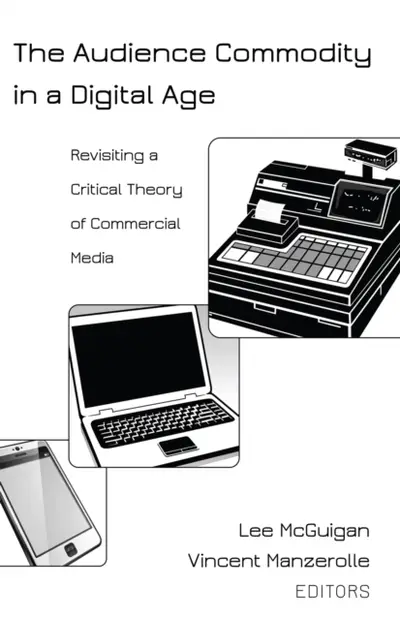
Audience Commodity in a Digital Age
Revisiting a Critical Theory of Commercial Media
- History
- Children's books
- Society & social sciences
- Economics, business & finance
- Technology & engineering
- Computing & IT
- Language & linguistics
- Reference
Price and availability
$43.99
Available in: Andorra, Austria, Australia, Belgium, Bulgaria, Canada, Switzerland, Cyprus, Czechia, Germany, Denmark, Estonia, Spain, Finland, France, United Kingdom, Guernsey, Greece, Croatia, Hungary, Ireland, Isle of Man, Iceland, Italy, Jersey, Japan, Liechtenstein, Lithuania, Luxembourg, Latvia, Monaco, Malta, Netherlands, Norway, Poland, Portugal, Romania, Sweden, Slovenia, Slovakia, San Marino, United States, Vatican City, South Africa
Stores: US, UK, Canada, EU, Australia.
Sign in to buyThe price is re-checked by the server before payment.
For personal use under the eBook licence.
- Format
- DRM
- Not stated by the publisher
- Language
- English
- Publisher
- Peter Lang Inc., International Academic Publishers
- Published
- 1 May 2013
- ISBN
- 9781453911570
- Subjects
- Public speaking guides, Journalistic style guides, Communication studies, Media studies, Sociology & anthropology, Economic theory & philosophy, Speaking in public: advice and guides, Communication studies, Sociology and anthropology, Economic theory and philosophy, Public relations, Publishing industry and journalism, Social and cultural history, Electronics and communications engineering, Digital and Information technology: general topics, Internet guides and online services, Computer networking and communications, Educational: Social sciences, social studies
About this book
This edited collection comprises foundational texts and new contributions that revisit the theory of the audience commodity as first articulated by Dallas Smythe. Contributors focus on the historical and theoretical importance of this theory to critical studies of media/communication, culture, society, economics, and technology - a theory that has underpinned critical media studies for more than three decades, but has yet to be compiled in a single edited collection. The primary objective is to appraise its relevance in relation to changes in media and communication since the time of Smythe's writing, principally addressing the rise of digital, online, and mobile media. In addition to updating this perspective, contributors confront the topic critically in order to test its limits. Contextualizing theories of the audience commodity within an intellectual history, they consider their enduring relationship to the field of media/communication studies as well as the important legacy of Dallas Smythe.
Bibliographic data © Gardners Books Ltd.