PDF · English
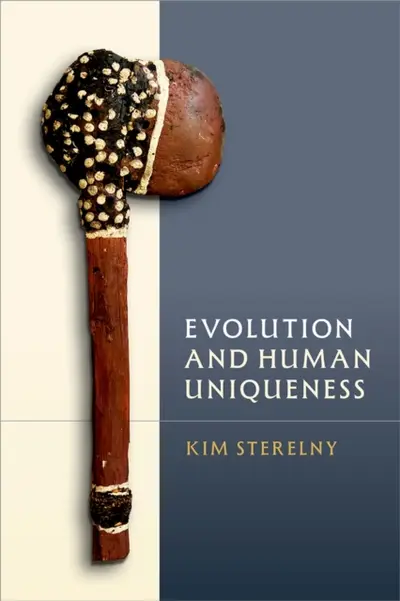
Evolution and Human Uniqueness
Price and availability
$33.99
Available in: Andorra, Austria, Australia, Belgium, Bulgaria, Canada, Switzerland, Cyprus, Czechia, Germany, Denmark, Estonia, Spain, Finland, France, United Kingdom, Guernsey, Greece, Croatia, Hungary, Ireland, Isle of Man, Iceland, Italy, Jersey, Japan, Liechtenstein, Lithuania, Luxembourg, Latvia, Monaco, Malta, Netherlands, Norway, Poland, Portugal, Romania, Sweden, Slovenia, Slovakia, San Marino, United States, Vatican City, South Africa
Stores: US, UK, Canada, EU, Australia.
Sign in to buyThe price is re-checked by the server before payment.
For personal use under the eBook licence.
- Format
- DRM
- Not stated by the publisher
- Language
- English
- Publisher
- Oxford University Press
- Published
- 18 September 2026
- ISBN
- 9780197834862
- Subjects
- Philosophy of science, Taxonomy & systematics, Early man, Philosophy of science, Taxonomy and systematics, Evolutionary anthropology / Human evolution
About this book
It is widely agreed that the human evolutionary story is puzzling. As both individuals and in groups, we contrast with all other large animals in our numbers, geographical spread, ecological impact, dependence on technology, and cooperation. This contrast evolved very rapidly^-^in just a few million years. Most theories of this transition identify a key innovation: a crucial adaptive change that powered the human revolution. This book develops and presents an alternative account of this transformation. Our ancestors' lifeways became dependent on high value resources. Such resources require some combination of technology, cooperation, knowledge, and skill if they are to be harvested reliability. Initially small differences in abilities to cooperate, learn socially, and use technology increased though positive feedback, allowing our ancestors to spread into new environments and new lands. By the emergence of our own species, or earlier, we had evolved the cognitive and social capacities to build information packages suitable to environments very different from our ancestral African homelands.
Bibliographic data © Gardners Books Ltd.