EPUB · English
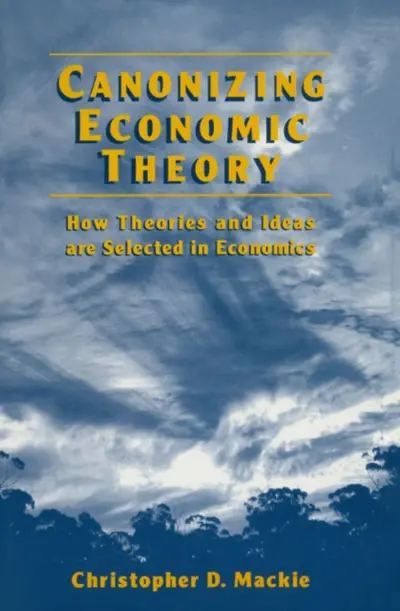
Canonizing Economic Theory
How Theories and Ideas are Selected in Economics
Price and availability
$45.99
Available in: Andorra, Austria, Australia, Belgium, Bulgaria, Canada, Switzerland, Cyprus, Czechia, Germany, Denmark, Estonia, Spain, Finland, France, United Kingdom, Guernsey, Greece, Croatia, Hungary, Ireland, Isle of Man, Iceland, Italy, Jersey, Japan, Liechtenstein, Lithuania, Luxembourg, Latvia, Monaco, Malta, Netherlands, Norway, Poland, Portugal, Romania, Sweden, Slovenia, Slovakia, San Marino, United States, Vatican City, South Africa
Stores: US, UK, Canada, EU, Australia.
Sign in to buyThe price is re-checked by the server before payment.
For personal use under the eBook licence.
- Format
- EPUB
- DRM
- Not stated by the publisher
- Language
- English
- Publisher
- Taylor & Francis
- Published
- 11 July 2016
- ISBN
- 9781315502311
- Subjects
- Philosophy, Economic theory & philosophy, History of scholarship (principally of social sciences and humanities), Economics, Philosophy
About this book
Historians of economic thought traditionally summarize, critique, and trace the development of existing theory. History of thought literature provides information about the authors, chronology, and relative importance of influential works. Generally missing from the literature, however, are answers to questions about why economic theory exists in its current form: Why have economists chosen the theories they have to represent the discipline's formal content? What are the criteria that determine the value of a theory, or of research in general; and, how have these criteria changed over time? In this insightful and well-written work, Christopher Mackie analyzes how ideas and theories are accepted in economics, from the pre-publication phase to the point at which, once written, a theory enters the accepted body of professional literature. Drawing from economics, the history of science, and philosophy, Mackie shows how both empirical and non-empirical criteria determine how theory will actually evolve.
Bibliographic data © Gardners Books Ltd.