PDF · English
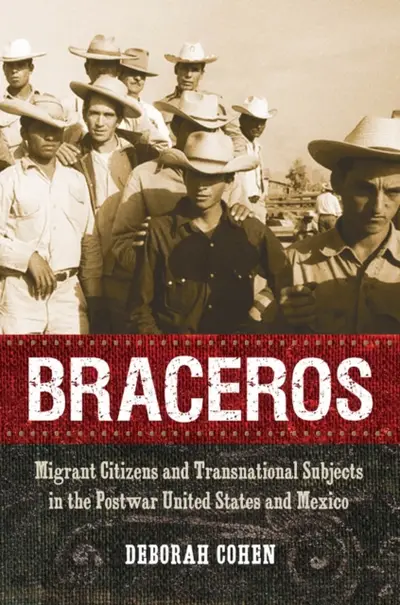
Braceros
Migrant Citizens and Transnational Subjects in the Postwar United States and Mexico
Price and availability
$81.99
Available in: Andorra, Austria, Australia, Belgium, Bulgaria, Canada, Switzerland, Cyprus, Czechia, Germany, Denmark, Estonia, Spain, Finland, France, United Kingdom, Guernsey, Greece, Croatia, Hungary, Ireland, Isle of Man, Iceland, Italy, Jersey, Japan, Liechtenstein, Lithuania, Luxembourg, Latvia, Monaco, Malta, Netherlands, Norway, Poland, Portugal, Romania, Sweden, Slovenia, Slovakia, San Marino, United States, Vatican City, South Africa
Stores: US, UK, Canada, EU, Australia.
Sign in to buyThe price is re-checked by the server before payment.
For personal use under the eBook licence.
- Format
- DRM
- Not stated by the publisher
- Language
- English
- Publisher
- The University of North Carolina Press
- Published
- 1 August 2013
- ISBN
- 9781469603391
- Subjects
- USA, Mexico, History of the Americas, Industrial relations, health & safety, Industrial relations, United States of America, USA, Mexico, Industrial arbitration and negotiation, Trade unions, History of the Americas
About this book
At the beginning of World War II, the United States and Mexico launched the bracero program, a series of labor agreements that brought Mexican men to work temporarily in U.S. agricultural fields. In Braceros, historian Deborah Cohen asks why these temporary migrants provoked so much concern and anxiety in the United States and what the Mexican government expected to gain in participating in the program. Cohen reveals the fashioning of a U.S.-Mexican transnational world, a world created through the interactions, negotiations, and struggles of the program's principal protagonists including Mexican and U.S. state actors, labor activists, growers, and bracero migrants. Cohen argues that braceros became racialized foreigners, Mexican citizens, workers, and transnational subjects as they moved between U.S. and Mexican national spaces.Drawing on oral histories, ethnographic fieldwork, and documentary evidence, Cohen creatively links the often unconnected themes of exploitation, development, the rise of consumer cultures, and gendered class and race formation to show why those with connections beyond the nation have historically provoked suspicion, anxiety, and retaliatory political policies.
Bibliographic data © Gardners Books Ltd.